
The 80-Year-Old Test: How to Make Decisions You’ll Never Regret
The framework Jeff Bezos used to build Amazon — and you can use tonight

There’s a version of my life where I’m still sitting at that desk.
I remained in the same office, with the same team that treated new ideas like a virus. I have the same paycheck that felt less like a reward and more like a leash. That’s a version of me that said yes too fast, got comfortable with the discomfort, and never asked the one question that would’ve changed everything.
I think about that version sometimes. Not with pity, but with terror.
Five years ago, I finished my master’s in computer graphics and did what most fresh graduates do: I panicked. One month before my final deadline, a big tech company reached out. They wanted me. Me: the kid who hadn’t even started sending CVs yet.
I said yes before thinking about it. Before I could compare or ask myself if I was aligned with the salary, the title, or anything else. The absence of uncertainty was enough.
For about ninety days, it felt like winning. But then the walls closed in. I found that the team was stagnant. The culture resisted change, and every idea I brought was met with the same polite wall. “Maybe in the future,” they said. But that future never came.
I wasn’t learning anything new. Instead, I was losing the sharpness, the curiosity, and the ambition I’d spent five years in university building. So, after one year, I was searching for a way out.
Three new offers came, and all of them were acceptable. They offered me good salaries in other big companies. But when I told each of them what I wanted — growth, purpose, and room to grow — they blinked. None of them called me back. But instead of grabbing the nearest raft, I let them all go.
I spent eight more months in the cage. My parents thought I was making a rushed decision, trying to leave. But eventually, the right door opened. I had an opportunity, I took it, and I am still working there. This job turned me from a developer who knew almost nothing into a senior engineer who learned more in three years than I thought possible in ten.
And now, when I look back, I see two crossroads: one made from panic, and the other from patience.
Somewhere in between, I accidentally discovered a framework that Jeff Bezos has used for every major decision of his life. He figured it out at 3 AM in 1994. I figured it out years later, sitting in a job I hated, turning down three paychecks because something in my gut said not yet.
He called it the Regret Minimization Framework. And once you learn it, every big decision in your life gets simpler. Not because it’s easier, but because it’s clearer.
This is the second issue of a four-part series: Systems That Decide for You.
Last week, we eliminated 90% of your daily decisions automatically. This week, we tackle the 10% that actually keeps you up at night. Subscribe so you don’t miss the rest. Issue 3 might give you permission to do something you’ve been afraid to do for a long time.
The Regret That Haunts You at 80
Psychologists Thomas Gilovich and Victoria Medvec spent years studying what people regret. Their findings are fascinating and a little unsettling.
In the short term, we mostly regret things we did. Maybe it’s the impulsive purchase, the text we shouldn’t have sent, or the yes that came too fast. My first job was a textbook action regret. I moved before thinking, and spent almost two years paying for it.
But here’s where it flips. In the long term, people overwhelmingly regret things they didn’t do. They regret the business they never started, the conversation they avoided, or the leap they didn’t take because the timing wasn’t perfect.
By 80, “I wish I had” always outweighs “I wish I hadn’t.”
This is the regret asymmetry. And it explains why my second decision, the one that looked crazy to everyone around me, turned out to be the smartest thing I’ve ever done. Saying no to three decent offers wasn’t inaction. It was the refusal to create a long-term regret just to relieve short-term discomfort.
But your brain can’t see this in the moment, that’s the problem. When you’re standing at a crossroads with your heart pounding and your palms sweating, your brain doesn’t think about age 80. It thinks about tomorrow morning and optimizes for relief, not meaning.
That’s why you need a framework that forces you to look further.
3 AM in a Manhattan Apartment
It’s 1994. Jeff Bezos is 30, working at D.E. Shaw, one of the most prestigious hedge funds on Wall Street. He has a great salary and a clear trajectory: the kind of career most people would protect with their lives.
But the internet is exploding. Bezos sees web usage growing at 2,300% per year and has an idea: an online bookstore. He takes it to his boss, who listens carefully and says something like: “That’s a really good idea. But it would be a better idea for someone who didn’t already have a good job.”
So Bezos goes home, defeated, and he can’t sleep.
At 3 AM, he creates a mental exercise that will eventually become the foundation of every major decision he’ll ever make. He calls it the Regret Minimization Framework, and it works like this:
Project yourself forward to age 80, sitting in that rocking chair. Look back at your life, and ask: which choice would I regret not making?
For Bezos, the answer took about ten seconds. He wouldn’t regret trying to build an online bookstore and failing. He could live with that. But he absolutely would regret never trying. It would follow him forever.
The story says Bezos quit his job the following week. He drove to Seattle, started Amazon in a garage, and the rest you already know. So, how can you apply that in your life?
Why Your Future Self Sees What You Can’t
This seems like the same old inspirational story about a billionaire, but there’s hard science behind why this simple exercise works so well.
Researchers Yaacov Trope and Nira Liberman developed the Construal Level Theory. When we think about events close to us, we process them concretely. We see logistics, obstacles, and everything that could go wrong. That’s where fear lives.
Yet, we process events that are far away more abstractly. We see values, identity, meaning, and opportunity.
When you ask, “Should I quit my job and start a business right now?”, your brain screams: Think about the mortgage and the health insurance! What will people think?
But when you imagine your 80-year-old self looking back at that same question, something shifts. The mortgage disappears, and the opinions dissolve. What remains is simple: did I live the life I actually wanted, or the one I settled for?
This framework works because it pulls you out of the weeds of today and drops you into the clarity of a lifetime. And from up there, the view is very different.
The Framework in Five Moves
Let’s make this practical. Here’s how to actually run the test.
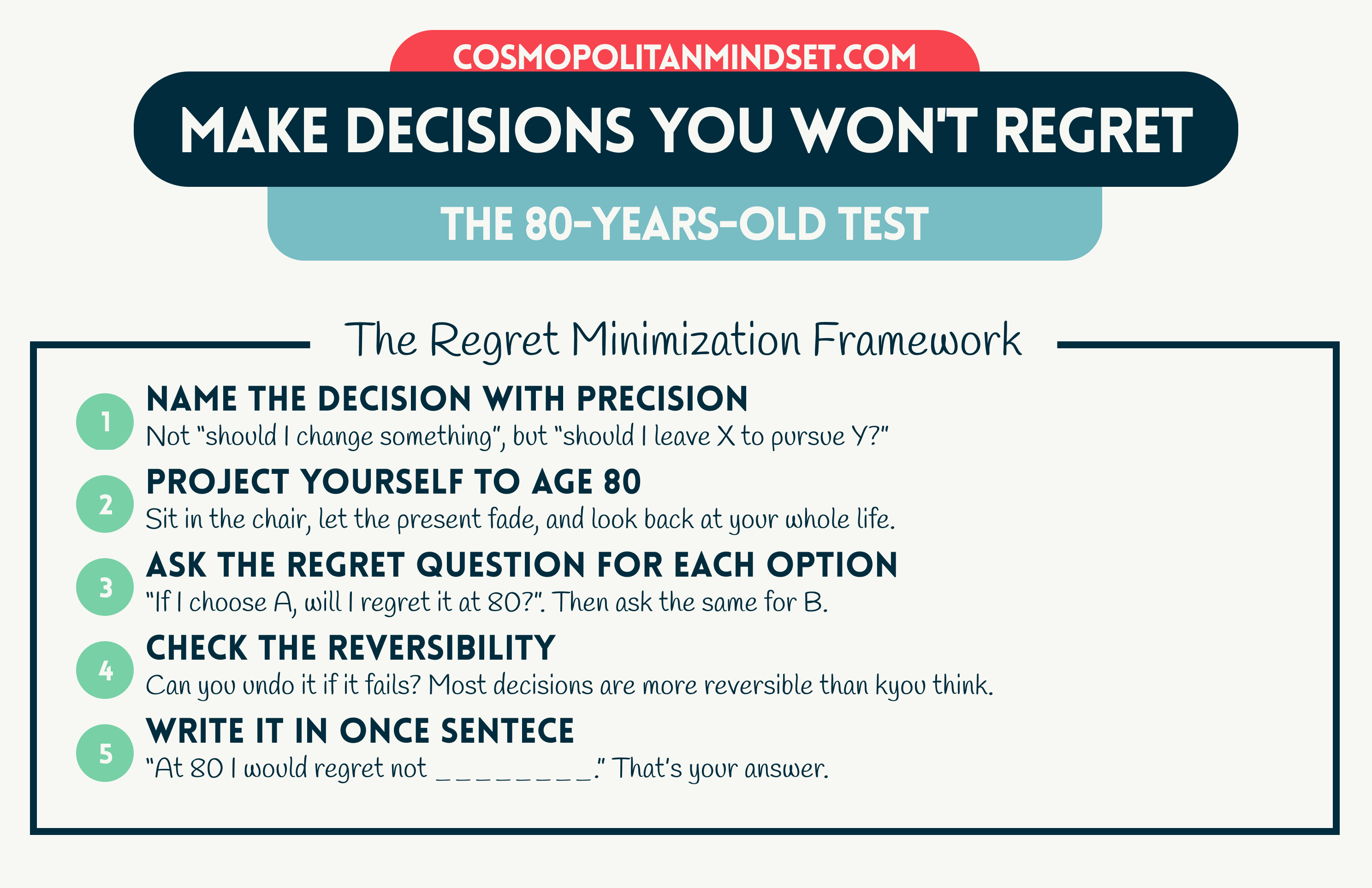
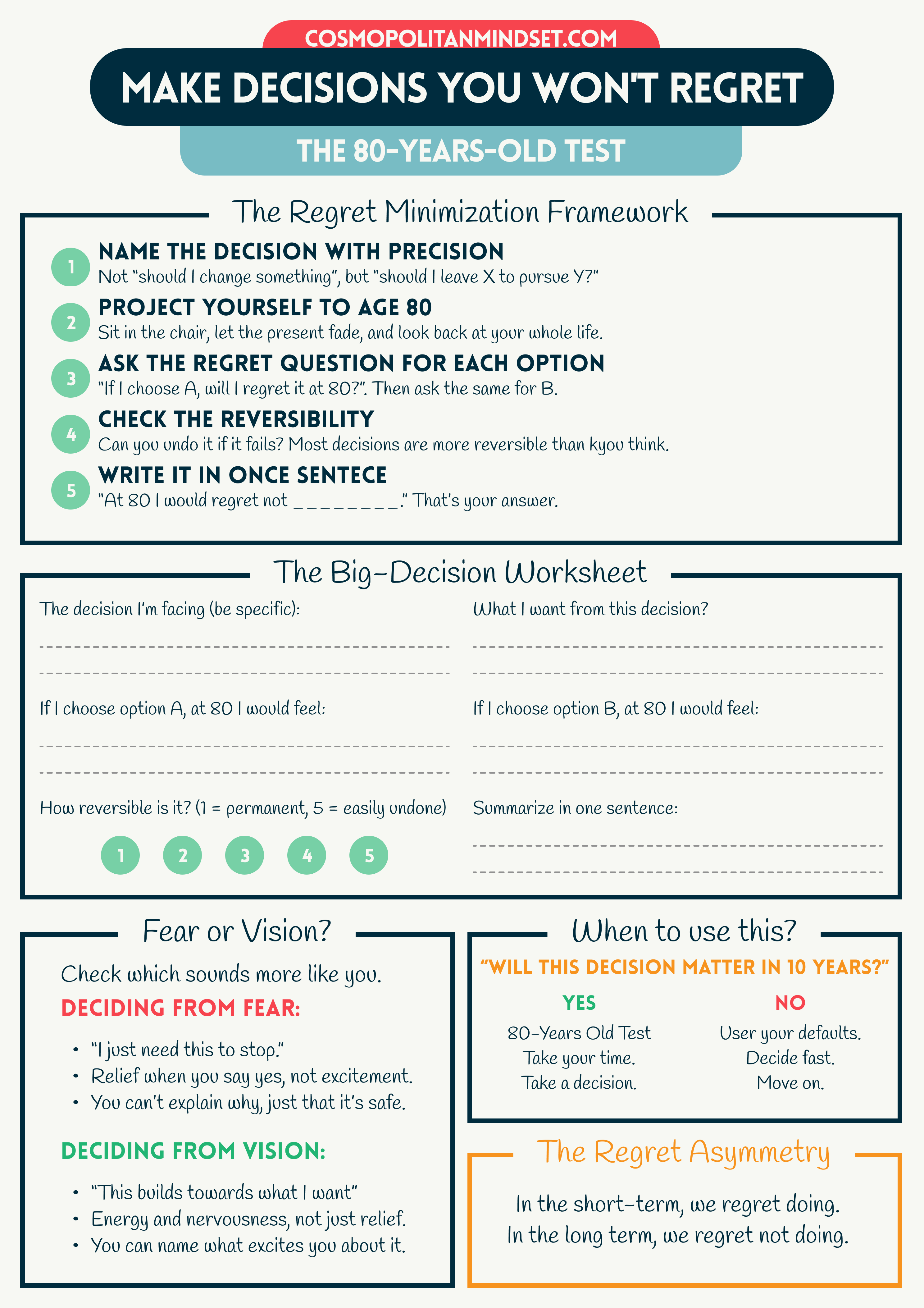
1 — Name the decision with precision.
First of all, it’s clarity. So, when making a decision, don’t be vague. Don’t say “should I change something?” but “should I leave Company X to pursue Y?” Don’t say “should I go back to school?” but “should I enroll in Z program starting in September, knowing it means giving up A and B?”
Vague questions produce vague answers.
2 — Project to 80.
Close your eyes and picture yourself old, comfortable, looking back at a full life. Try to go there mentally. Sit in that chair for a minute, and let the present fade.
3 — Ask the regret question for each option.
Now, you can ask the question: “If I choose Option A, will I regret it at 80?” Then: “If I choose Option B, will I regret it at 80?”
Answer both of them. If you skip the second one, you may regret not choosing an option. And that is heavier than failing.
4 — Check the reversibility.
Don’t forget to keep a safeguard. Ask yourself, “How reversible is this?”
If you quit a job and it doesn’t work out, can you find another one that suits you? You could. If you miss an opportunity and it disappears, can you retrieve it? Probably you could.
Most decisions we agonize over are far more reversible than we think. That alone should give you courage.
5 — Write it down in one sentence.
“At 80, I would regret not _______.”
Fill in the blank with your answer. You don’t need a paragraph or a pros-and-cons list. One sentence gives enough clarity to choose.
If you built your decision defaults from last week’s issue, you’ve already freed up the mental energy for exactly this kind of deep thinking. Your defaults handle the noise. This framework handles the signal.
When NOT to Use This
The Regret Minimization Framework is designed for the 5 to 10 decisions per year that genuinely shape your trajectory. That means your career moves, business pivots, relationships, or big financial commitments. Those are the decisions that still matter a decade from now.
The framework is not for choosing what to have for lunch or whether to answer that email now or later. Those decisions have a system, and using this framework on small choices would be overkill.
Will this decision still matter in 10 years?
If yes, run the test. If no, use your defaults.
Also, be honest with yourself. If you already know what you want to do and you’re using this framework to justify it, that’s not clarity. That’s confirmation bias wearing a clever disguise. The framework is for discovering the answer, not decorating the one you’ve already picked.
Are You Deciding from Fear or Vision?
Now, let’s face one last reality. Are you deciding from fear or vision?
Here are three questions you can use to understand that:
“Am I choosing this because it removes discomfort, or because it builds toward something I actually want?” My first job, for example, was me trying to escape discomfort. I didn’t build anything.
“Am I saying yes because I’m excited, or because I’m afraid of what happens if I say no?” Fear-based yeses are quiet. They don’t come with energy, but with a sigh of relief.
“If I imagine myself at 80, which choice makes me proud?” Don’t think about being comfortable or safe, but proud.
If your answers point toward fear, pause. That doesn’t mean don’t decide, but don’t decide yet. Give yourself the space to find the option that pulls you forward instead of just pushing the anxiety away.
The Challenge of The Week
There’s a version of my life where I never found the job I have today. I took the first decent offer, spent another year in the wrong place, and slowly forgot what I was capable of. That version of me might be comfortable enough. But he wouldn’t have the skills, the confidence, and the stories I get to tell in this newsletter.
He would be sitting in that rocking chair at 80, wondering what if.
So here’s your challenge.
Think of one big decision you’re currently facing or avoiding and run the five steps.
Write your one sentence. “At 80, I would regret not ______.”
Don’t act on it yet if you’re not ready. But look at it. Sometimes clarity is the first step, and courage follows.
What if you realize, after running the test, that you’ve been holding onto something that isn’t working? What if you’re staying in a job that your 80-year-old self would tell you to leave?
That’s a different kind of decision. And it requires a different kind of framework.
Next week, we’ll talk about the thing nobody wants to talk about: quitting. It’s not about giving up or failing, but strategic and intentional quitting. And why the best decision-makers in the world do it all the time.
See you then.
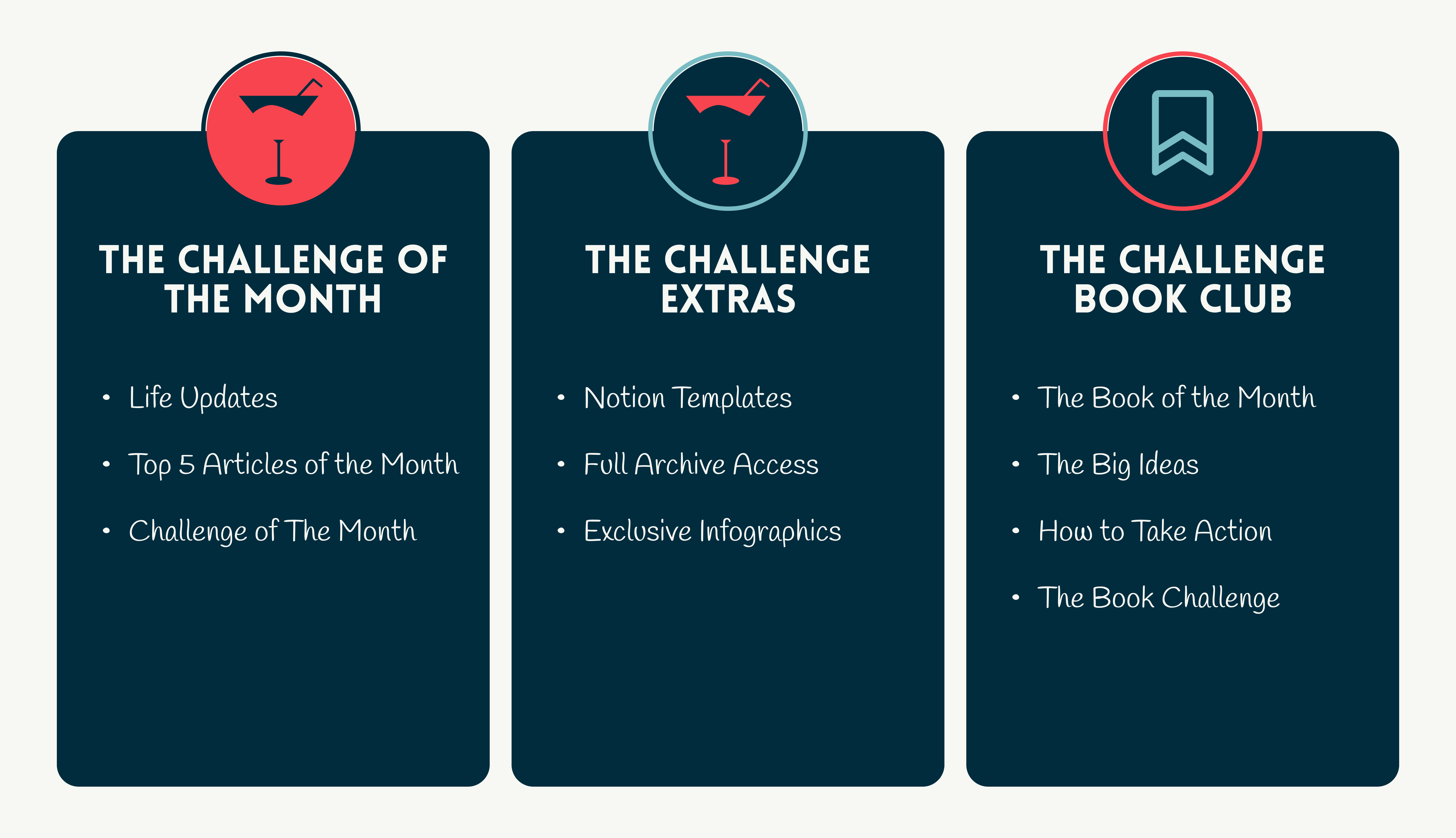
If this is the kind of thinking you want more of, paid subscribers get three things I don’t publish anywhere else: my personal column on the 1st of each month — what I’m reading, what’s happening in my life, and the 5 articles from other writers worth your time — a full book breakdown whenever I finish something worth sharing, and 10 Notion templates built around the systems I cover here. It’s $5/month.
Cosmin, The Challenge