
The Worst Article I Ever Wrote Was the One That Made Me a Writer
What six years of shipping bad work taught me about getting started

This issue is sponsored by Focusaur!
Just Start: A Focus Tool That Makes Follow-Through Easier
For a lot of us, the hard part isn’t setting goals — it’s actually getting started before distraction takes over. Focusaur is a physical focus companion that helps turn intention into action with one twist, not one more app. If you want a more tangible way to stay consistent, start faster, and build better focus habits, Focusaur was made for exactly that.
Back Focusaur on Kickstarter and make starting feel easier.
It’s somewhere on your computer right now.
Maybe it’s in your draft folder or a notes app — a piece of writing, video, or pitch you keep telling yourself you’ll publish when it’s ready. But you’ve been saying that for weeks, months, or years.
I want to tell you about the moment I learned “when it’s ready” was a trap.
It’s February 29, 2020. I’m home alone because COVID has closed everything. The exam session ended, the next semester will be online, and we’ve been sent home indefinitely. I have a 1,200-word document open titled “The Absolute Power of Talking to Yourself,” which I’m about to publish.
I read it one more time as if I could make it better.
It’s bad, and I am aware. The structure is off, the metaphors don’t land, and the conclusion repeats the introduction. I’ve spent almost two years reading personal-development books. I can tell when a piece of writing is working, but this one isn’t.
I click publish anyway, and the article earns 41 reads, 160 views, and $0.17. I wouldn’t have given it one cent.
I told this story in my 100th newsletter last September. At that time, I wanted to show you how I started monetizing my writing and how you could do the same. Compared to the first one, that piece gathered a little bit more success. Eight thousand of you read it. But the argument was wrong.
The $0.17 was never the point. The point is what publishing it did to me, six years ago. The same thing is waiting for whatever’s in your draft folder. Today, we are making it public.
Every Monday, I send one of these. Subscribing is free if you want it in your inbox.
What 30:1 Failure Looks Like
In 2002, after ending a sitcom that earned him a billion-dollar deal, Jerry Seinfeld did something most successful comedians never do. He went back to small clubs in New York and started over.
The documentary that came out of that period, Comedian (2002), shows him at the Comedy Cellar with a notebook full of half-finished bits, flopping in front of crowds of fifty people. And even if he failed Tuesday and Wednesday, on Thursday, he showed up again with the same material, slightly rephrased.
Years later, Seinfeld estimated that for every minute of comedy that works, he writes and tests roughly thirty minutes of unusable material in clubs. The ratio is 30:1, which means the thirty minutes don’t become one. They get cut, but only after the public test.
Most people who want to be writers, builders, or creators are operating at a 1:1 ratio. Every minute of work has to be a minute that lands. So when they write something, they delete it if it looks bad. But this way, the work never gets tested, and the cutting happens before the publishing.
That’s not how skill develops in any creative field I know of.
Why “Don’t Publish Bad Work” Is the Wrong Advice
The conventional wisdom on creative work is wrong.
Build skill in private, publish only when you’re proud of the output, and protect your reputation. That’s how the advice sounds. But that’s also, in my experience, the most effective way to never become a creator at all.
The reality is that, with zero audience, there is no reputation to protect. Nobody is watching. The bad work you’re terrified of putting into the world will be seen by twelve people, six of whom are bots and four of whom are family members. Your fear is real. But the audience that fear is protecting you from doesn’t exist (yet).
Skill in private is also a different muscle than skill in public. Private writing teaches you what’s interesting to you. Instead, public writing teaches you what survives contact with a reader who didn’t ask for it. They’re different jobs. You can spend ten years getting excellent at the first one and remain a complete beginner at the second.
Reid Hoffman, the founder of LinkedIn, once said: “If you are not embarrassed by the first version of your product, you’ve launched too late.” He was talking about software, but the principle holds for any creative output. Embarrassment isn’t a sign you’ve failed. It’s a sign you shipped early enough to learn from it.
So don’t avoid the work that should develop your public muscle.
What the Research Shows about Publishing Bad Work
In the late 1980s, a psychology professor named Robert Boice ran a study at SUNY Stony Brook on academic writers. He divided them into three groups:
writers who only wrote when inspired
writers who forced themselves to write daily
and a control group.
After ten weeks, the daily writers had produced more pages. But that’s to be expected. The unexpected result was that the daily writers also produced more creative ideas. The forced-routine group reported new insights at roughly twice the rate of the inspiration group.
So what can we learn from this?
Regular, low-stakes output produces both volume and creative breakthrough at the same time, because the act of writing is what surfaces the ideas, not the other way around.
Edna Foa at the University of Pennsylvania pioneered exposure-based therapy for anxiety disorders. Her work shows that people exposed to a feared stimulus, without catastrophic consequences, experience weaker fear responses. The brain learns that the threat is not real.
Publishing bad work is the writer’s version of exposure therapy. The first publication is terrifying. By the twentieth, the fear circuit has stopped firing. You might not be a better writer in those twenty publications. But you’ve stopped being afraid. You have more confidence. And that reflects in your work.
Once the fear is gone, you can focus on improving your craft. But you have to get it out of that draft folder first.
How to Start Before You’re Ready: Six Moves That Work
If the file in your draft folder has been there longer than a month, the issue isn’t quality. The muscle hasn’t been built yet.
Here are the six moves that worked for me, six years, more than 160 articles, and more than 150 newsletters in.
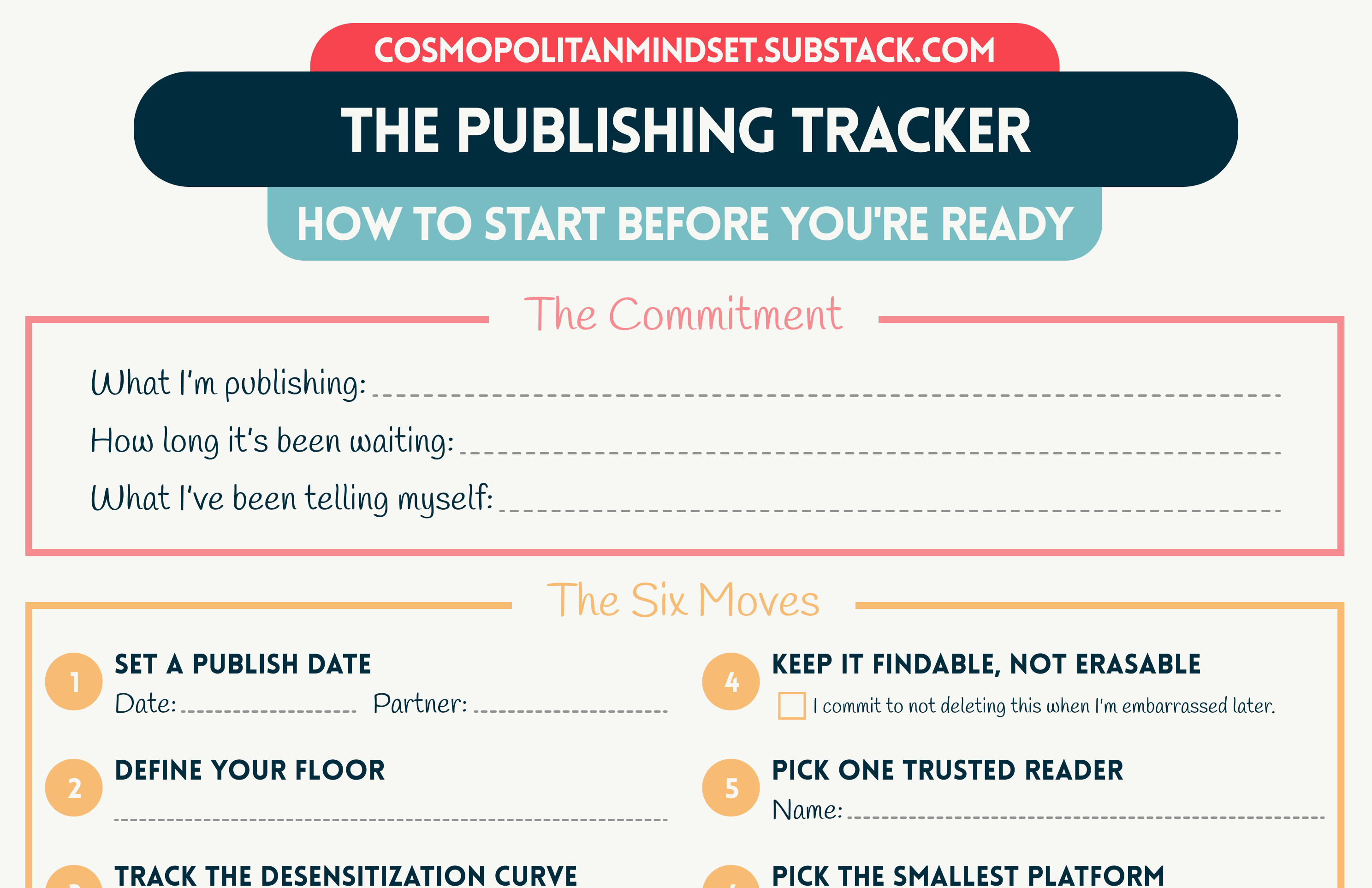
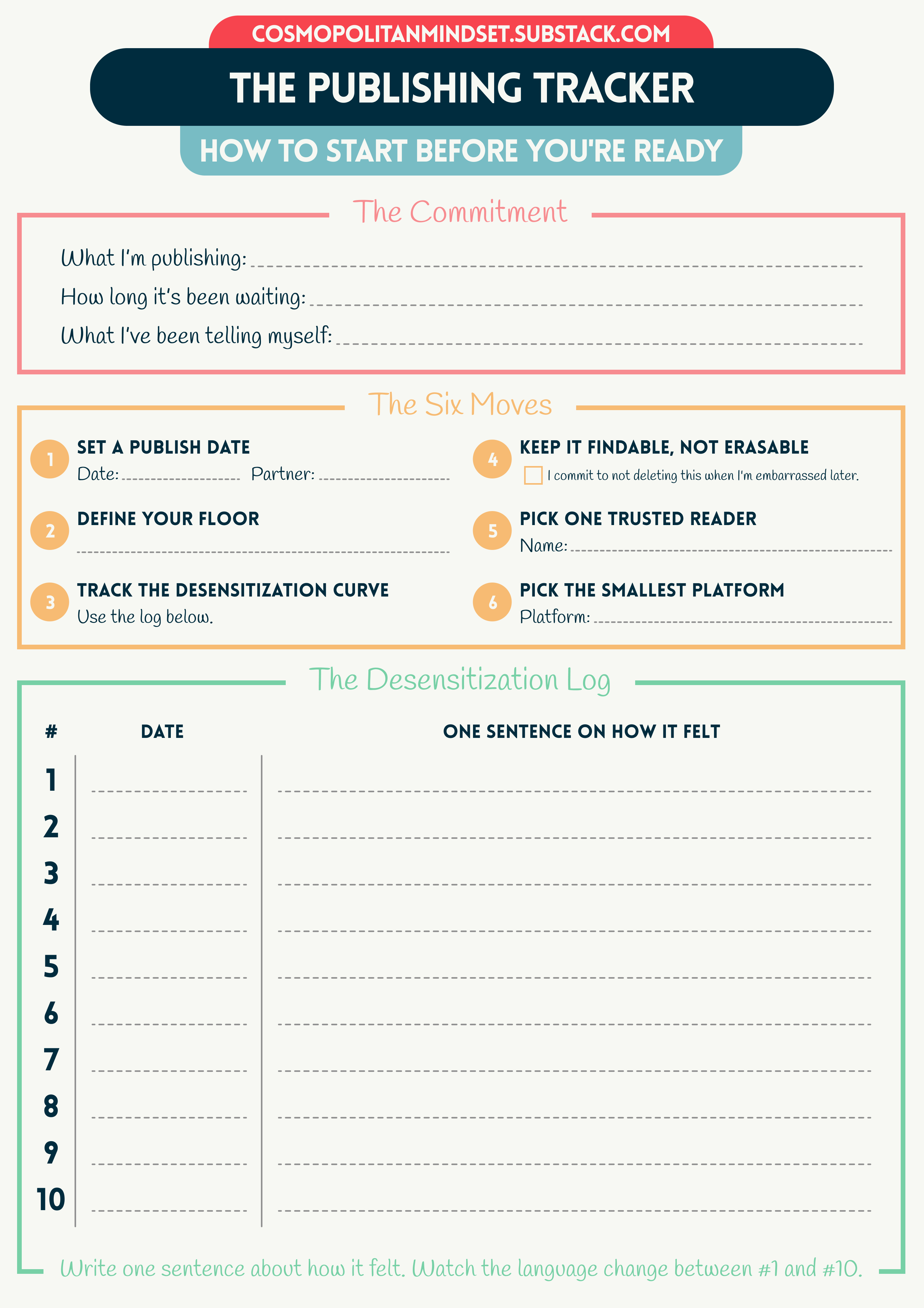
1. Set a publish date before you start the work.
A deadline turns quality from an unbounded target into a bounded one.
Without a date, you can always argue for one more revision. But with a date, the question becomes “Is this ready enough?” So pick a date this week and tell someone what you are going to do. Your accountability partner is the structural change that will ask news about your project and force you to push through.
2. Lower the floor, not the ceiling.
Most creators set high-quality bars. They want their product to be excellent before they ship it. But you need to reverse that trend.
Set a low-quality bar instead. When would you be willing to put your name on this project and have it exist publicly forever? Focus on that floor level and, once you reach it, publish your work.
3. Track the desensitization curve, not the quality curve.
In your first ten publications, your quality curve will be roughly flat. Your desensitization curve will be steep. But that’s because you are changing your nervous system, not your skill.
After every publish, write one sentence about how it felt. Watch the language change between publish one and publish ten. You will notice the difference by the tenth publication.
4. Make the embarrassing work findable, not erasable.
Publishing is only the first step. But it doesn’t end there because you will feel the impulse to unpublish bad work to maintain an idealized public self.
Resist it.
Visible past badness is the only proof that a real growth trajectory exists. Six years later, my $0.17 article is still live on Medium. And I won’t edit or delete it. It’s the cheapest piece of evidence I own that I started somewhere worse than where I am now.
5. Show the next bad piece to one trusted reader before publishing.
Feedback at scale is overwhelming and noisy. People could praise you to get something in exchange. Or you might find a hater who will crush your dreams. Instead, feedback from one trusted reader is a signal.
Find a person who could give you that signal. It could be a colleague, a friend whose business judgment you trust, or an honest study partner. One reader is the smallest possible audience, but it still counts as an audience. And it can provide the feedback that helps you understand how to improve.
6. Publish on the smallest platform you have access to.
The instinct to start big and launch in the most prestigious place you can reach backfires for the first ten publications. When I started with Medium, The Startup was one of the best places to publish your work. But I couldn’t reach them, and even if I could, it wouldn’t have benefited me.
Reaching many people with a bad product is not what you want. You want a low-stakes environment for the desensitization to happen. So it’s better to start with a small audience, get feedback, round the edges, and then aim for the big dogs.
It took me 7 independent articles before I found a small publication of 2k readers.
After 10 more articles, I landed a piece on a publication with around 70k readers.
Around the 25th article, I grew to 400k readers.
But only 70 articles later, I reached The Startup and its 700k readers.
Are you willing to publish 20 pieces of work before one of them makes an impact?
The Challenge of The Week
I reread “The Absolute Power of Talking to Yourself” before writing this. Six years on, every paragraph still makes me wince. But I’ll never edit it because it’s evidence that the version of me from February 29, 2020 — the one who thought clicking publish on something bad would disqualify him from ever being a writer — was wrong about what would happen.
This week, publish the thing in your draft folder. Stop polishing it and put it online. Or, if you don’t have a draft folder, write the first 500 words of something you’ve been thinking about and share that.
The metric isn’t quality. The metric is: Did you click publish?
Nothing happened after I published my first article. Nobody mocked me. Nobody rescinded permission. The internet absorbed it and moved on. The only thing that changed was that I had done it once. That made the second time easier, and the hundred-and-tenth inevitable.
The file in your draft folder is waiting for the same thing.
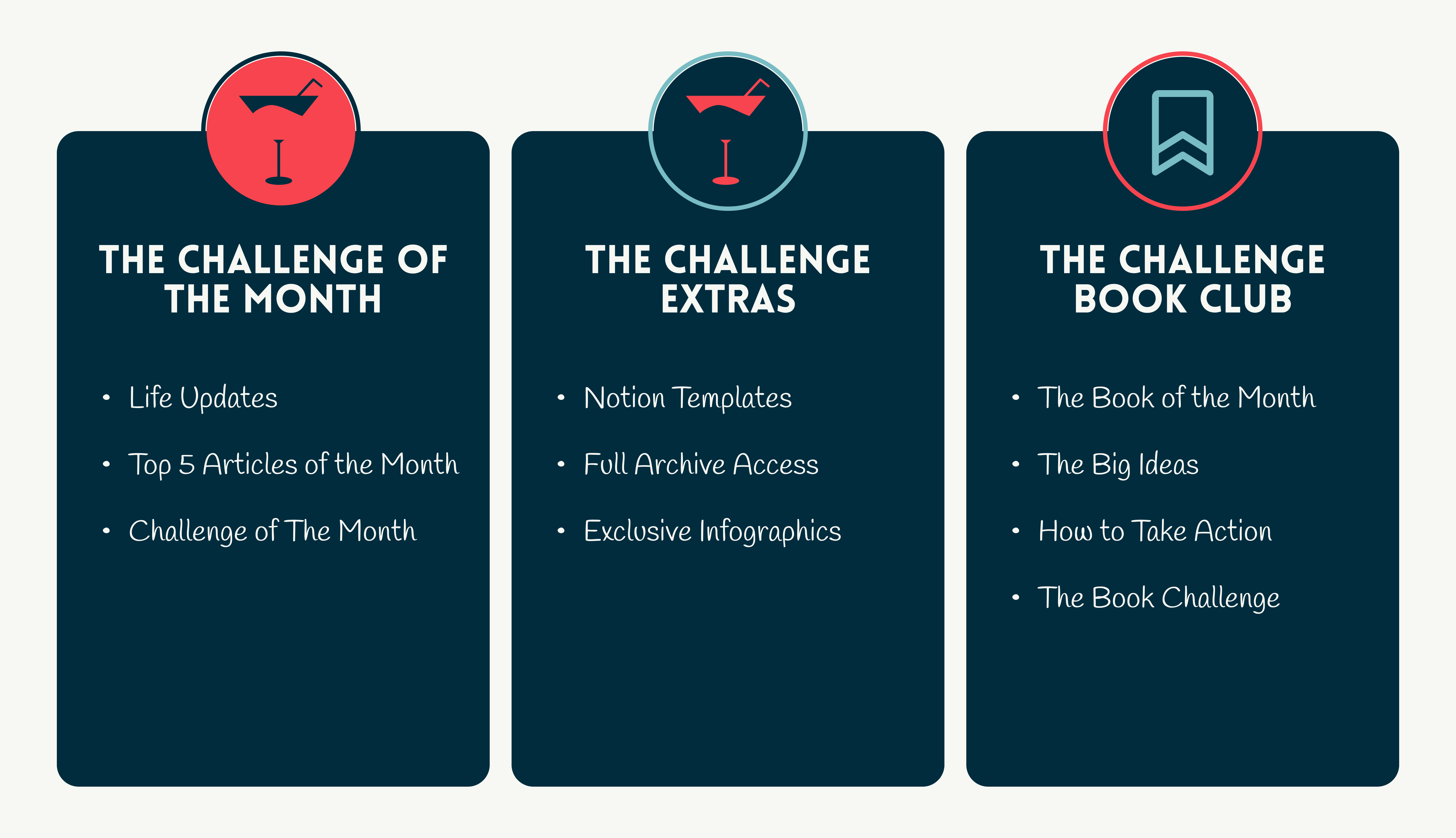
If this kind of thinking is what you came here for, there's more on the other side. Paid subscribers get my personal column on the first of each month — what I'm reading, what's happening in my life, and the 5 articles from other writers worth your time — a full book breakdown whenever I finish something worth sharing, and 10 Notion templates built around the systems I cover here. None of it is published anywhere else.
Cosmin, The Challenge