
The Rejection Portfolio: Why I’m Collecting My Failures Like Rare Coins
How deliberately seeking ‘no’ became my fastest path to yes—and why you need a rejection strategy, not just a success plan

I’m sitting in a café in Turin. I have my laptop open, staring at a list I never thought I’d create.
It’s not a to-do list. Not a goal tracker. Not another productivity framework I found at 2 AM during an existential crisis.
It’s a rejection list.
Twenty-three business owners I’m going to pitch this month. Twenty-three people who will probably tell me no. Twenty-three opportunities to fail spectacularly at selling websites to restaurants that didn’t ask for them.
And here’s the part that would’ve horrified the younger version of me: I’m excited about it. Not because I’m secretly a masochist. Not because I’ve suddenly developed superhuman confidence. But because somewhere between my grit articles and my 3 AM revelations about productivity, I stumbled onto something most people get backwards.
We’ve been taught to handle rejection. But nobody taught us to hunt for it.
The difference isn’t semantic. It’s systemic. And it’s the reason why some people build empires while others build elaborate excuses.
Let me show you what I mean.
The Archive Nobody Wants (But Everyone Needs)
In 2012, a guy named Jia Jiang did something most people would consider insane. He decided to get rejected, on purpose, for 100 days straight.
He asked to borrow $100 from strangers. He requested to make an announcement over a grocery store intercom. He tried to get free burgers. He asked if he could plant flowers in someone’s backyard.
He documented every single “no,” and something strange happened.
By day 30, rejection stopped feeling like a threat. By day 60, it started feeling like a game. By day 100, he’d built something most people spend their entire lives avoiding: a genuine comfort with rejection.
Jiang discovered something neuroscience has been backing up for quite some time: your brain treats social rejection like physical pain. The same neural pathways light up. The anterior cingulate cortex and the insula, the parts of your brain that process pain, activate when someone says no to you.
But just like physical pain, you can build tolerance.
That’s not motivational speak. That’s exposure therapy. It’s science. And that’s exactly what I’m testing on myself right now.
🚀 Unlock the Full Archive, the Productivity Mastery Notion templates, the Top 5 Articles of The Month, and The Challenge Book Club with the premium subscription!
The Fear Inversion Principle
I’ll be honest with you.
When I wrote that list of 23 business owners, my stomach twisted. Not because I thought they’d laugh at me (though some might). Not because I feared looking stupid (though I probably will).” But my brain kept whispering the same thing it’s been whispering for years:
“What if they say no?”
With time, I realized that the question is the problem. Most of them will say no. Maybe all of them. And if I’m waiting until I’m ready or my pitch is good enough to handle rejection comfortably, I’ll be waiting forever.
You're trapped in the anxiety loop:
You imagine rejection.
Your brain processes it as pain.
You avoid the situation.
The fear grows.
Repeat.
But researchers have known for decades that anticipation is worse than the actual event. A study published in Psychological Science found that people consistently overestimate how bad rejection will feel — and underestimate how quickly they’ll recover from it.
Think about it. That email you were terrified to send. The pitch you rehearsed 47 times. The moment after they said no, it probably stung for… what, an hour? Maybe a day?
The fear of rejection is almost always worse than rejection itself.
So what if we flipped it? What if instead of trying to avoid rejection, we actively pursued it?
The Portfolio Strategy: Turning ‘No’ Into Intel
Most people treat rejection as a binary outcome. Success or failure. Win or lose. Move forward or give up.
But what if each rejection is actually data?
When that first business owner told me they weren’t interested in my website pitch, my initial reaction was to feel defeated. But then I asked myself: Why weren’t they interested?
Was it the pitch? Did I fail with timing? Was my value not clear enough? Did they already have a website? Were they happy with it? Did they not see the need?
Every “no” became a piece of market research I didn’t have to pay for. That’s what made me think I could document them. Not just “Restaurant X rejected me,” but:
What I pitched
How they responded
What objection they raised
What I learned
What I’ll test differently next time
This is the rejection portfolio. And it works across everything: cold emails, newsletter promotions, partnership pitches, job applications, and creative submissions.
Each rejection reveals something:
Pattern recognition → After five similar rejections, you spot trends. Maybe your pricing is off. Maybe you’re targeting the wrong audience. Maybe your opening line buries the value.
Pivot points → Sometimes a rejection opens a door you didn’t know existed. “I’m not interested, but my colleague might be.” Or “Not right now, but check back in three months.” Or “I don’t need this, but I need that.”
Desensitization → Here’s the psychological magic: the 10th rejection genuinely hurts less than the first. Your brain calibrates. What once felt catastrophic starts feeling routine.
We’re not trying to develop thick skin. We’re trying to develop smart skin: a version that feels rejection, learns from it, and moves forward anyway.
How to Build Your Rejection Muscle
Okay, enough theory. Let’s build that portfolio.
1 — Choose Your Rejection Zone
Where are you most afraid of hearing “no” right now? That’s where you start.
For me, it’s pitching local businesses for web design. For you, it might be promoting your side hustle, asking for a raise, reaching out to potential collaborators, or submitting your work to publications.
Pick the thing that makes your stomach twist. That’s your training ground.
2 — Set a Target
I’m going for 23 pitches this month. But you don’t need to match that. Start smaller if you need to. Try 10 or even 5 rejections in 30 days.
The number matters less than the commitment to actively seek the “no.” But that doesn’t need to happen. It could also be a “yes.”
3 — Build the Tracking System
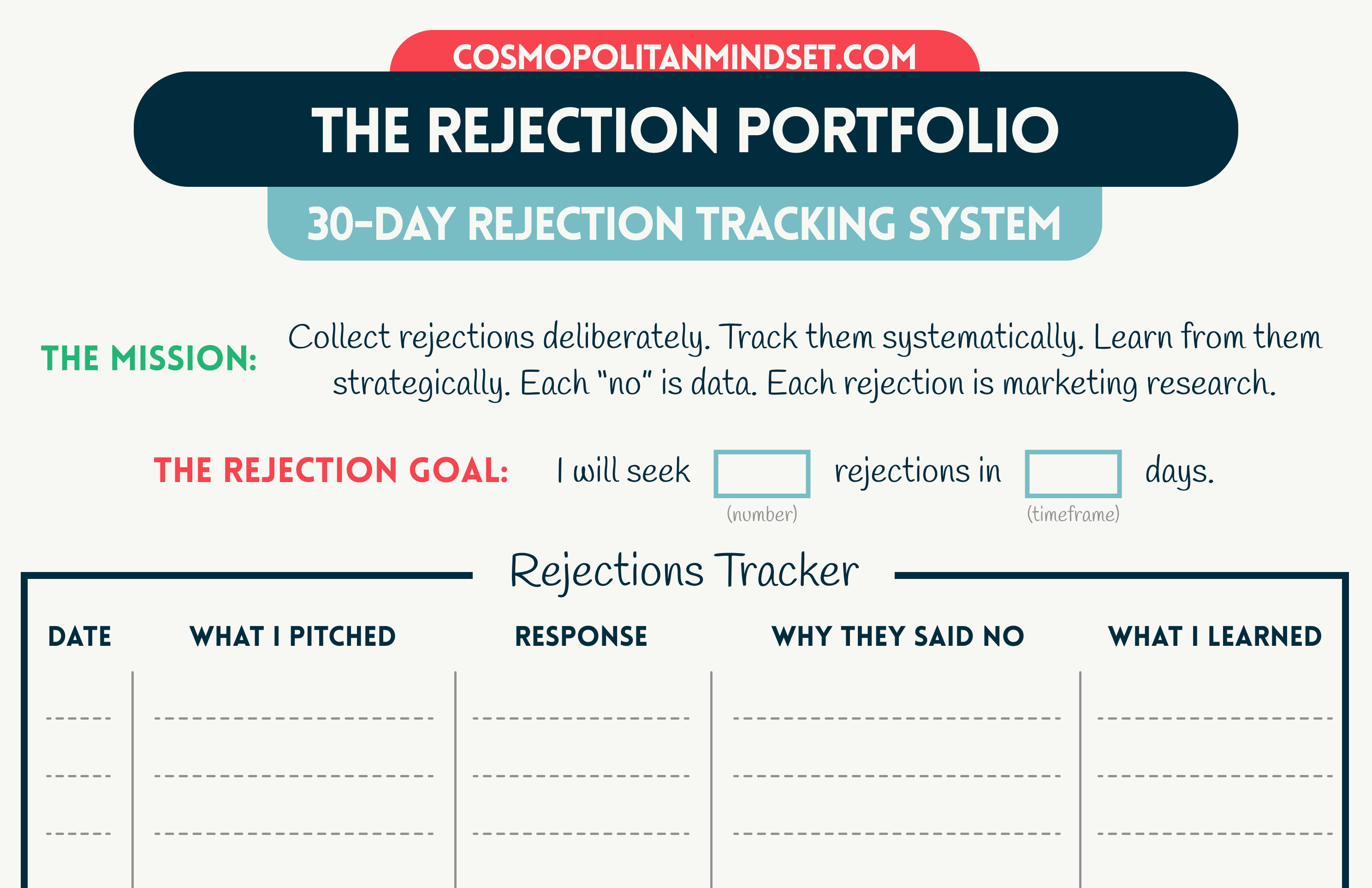
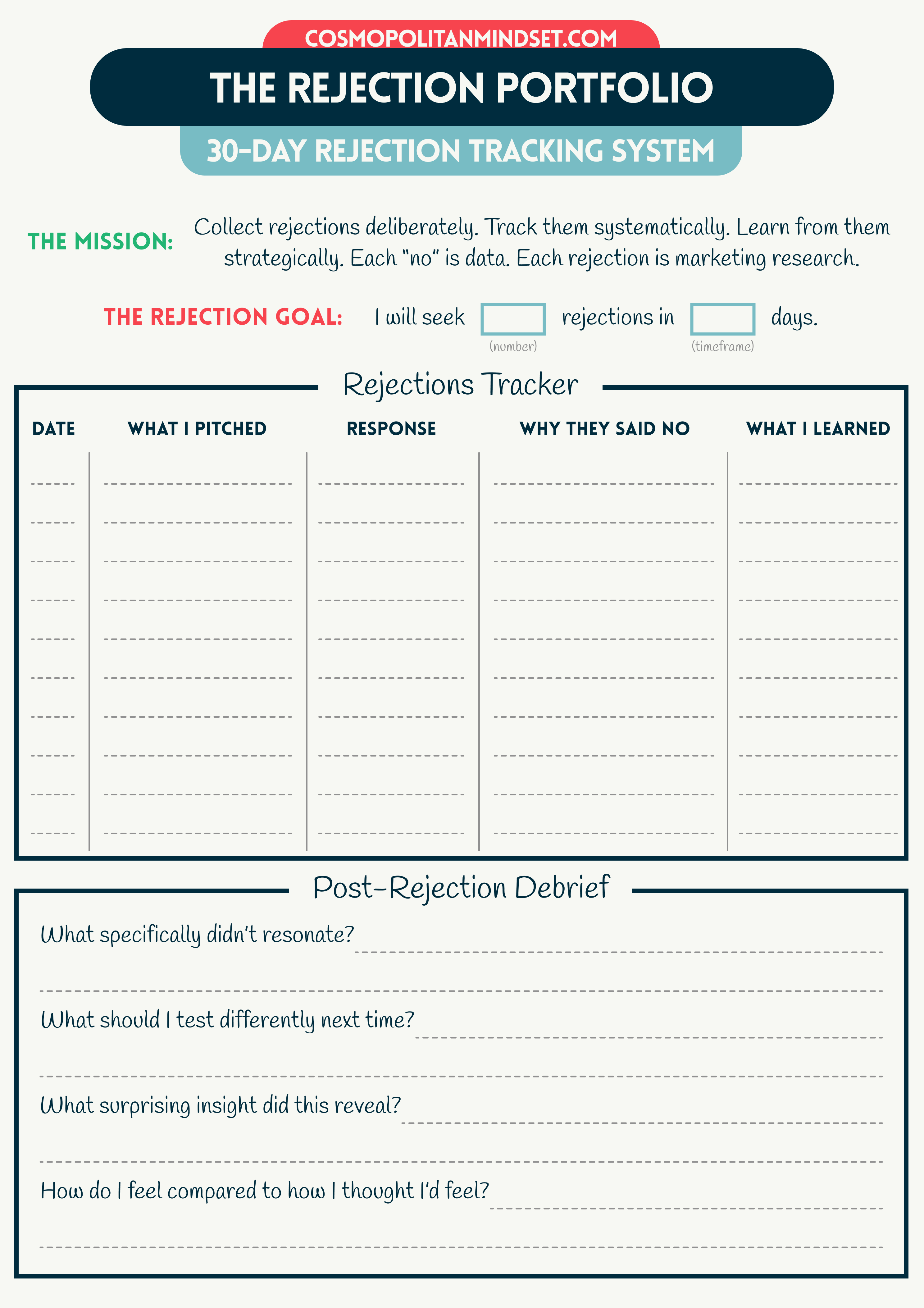
Open a document (or print the infographic below) and write five columns:
Date
What I pitched / asked for
Their response
Why they rejected me (best guess)
What I learned
That’s it. No fancy systems. No elaborate spreadsheets (unless that’s your thing). Just document the data.
4 — The Post-Rejection Debrief
Within 24 hours of each rejection, spend 5 minutes answering these:
What didn’t resonate?
What would I test differently next time?
What surprising insight did this reveal?
How do I feel compared to how I thought I’d feel?
The last question is crucial. You’re training your brain to recognize that rejection isn’t as catastrophic as it imagines.
5 — Iterate, Don’t Ruminate
The difference between collecting rejections and just failing is that you use what you learn.
After every three rejections, adjust something: your pitch, your target audience, your timing, your approach.
The rejection portfolio should help you accelerate learning more than accepting defeat.
The Counterintuitive Truth About Success
What’s the difference between people who succeed and those who don’t?
It’s not talent. It’s not luck. It’s not even persistence in the traditional sense.
It’s their rejection-to-success ratio.
Stephen King’s first novel, Carrie, was rejected 30 times before someone said yes. He literally threw the manuscript in the trash. His wife pulled it out.
The Beatles were rejected by Decca Records with the famous line: “Guitar groups are on their way out.”
J.K. Rowling received 12 rejections before someone took a chance on Harry Potter.
These are not exceptions. They are the rule.
A study on high-performing entrepreneurs found that successful founders don’t have fewer failures than unsuccessful ones. They have more attempts. More pitches. More products launched. More things that didn’t work.
Think about it. If your success rate is 10% (which is actually pretty good for most things), you need 10 attempts to get one win. If you’re so afraid of rejection that you only try twice, you’re almost guaranteed to fail.
The rejection portfolio is permission to play the number game.
The Challenge of The Week
I’m still sitting at this café staring at this list.
I’ve contacted eight restaurants so far. I got three rejections, two non-responses, and three are still pending. And what’s weird is that I’m not discouraged. I’m curious.
What will rejection number 10 feel like? What pattern will emerge by rejection 20?
This year isn’t built for success. This year is built for trying things. And trying things means collecting failures like rare coins that teach you something wins never could.
So, here’s a 7-day rejection experiment for you.
Pick something you’ve been avoiding because you’re afraid of hearing “no.” Something where rejection feels likely but not guaranteed.
Then go get rejected actively and deliberately. Let’s try three times this week. By the third rejection, you’ll notice how different it feels from the first.
I’m betting that by the end of the week, you’ll discover two things:
Rejection wasn’t as painful as you imagined.
You learned something valuable from every “no.”
And maybe — just maybe — one of those rejections will surprise you with a yes.
Your rejection portfolio isn't a sign of failure. It's proof you're in the arena.
Before You Go
How did your last rejection feel? How much did it last? Let us know below so we can all gain power from that!
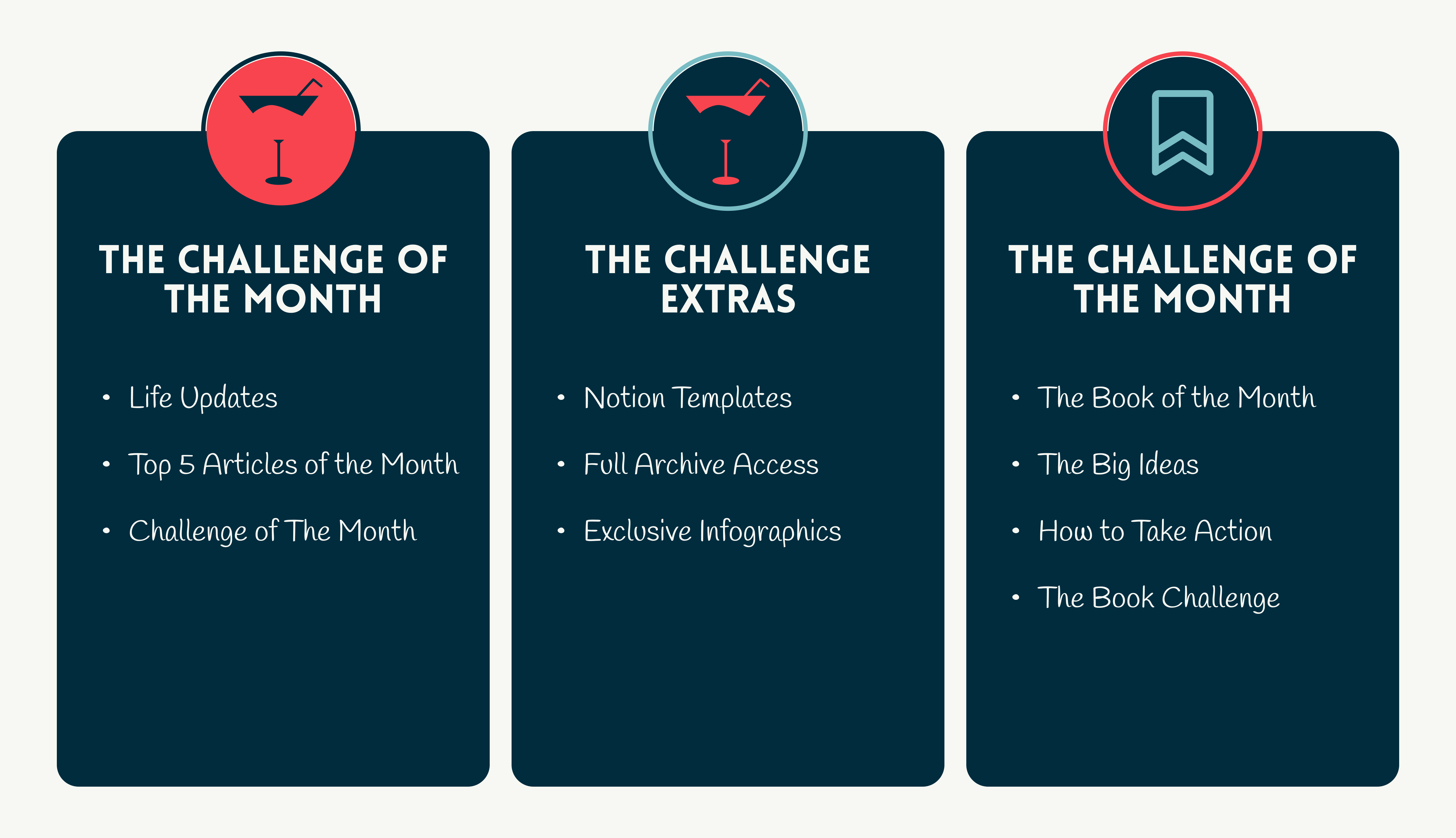
Get The Challenge’s full kit now! Go premium to unlock:
— Cosmin