
The One More Rule: A Simple Productivity Hack That Actually Works
Stay two minutes longer, ask one more question, send one more invite — and watch what happens.

It happens in the space between finishing and stopping.
You close the last email. You check off the final task. You feel that small dopamine hit of completion. And then, nothing.
You stand up, scroll your phone, and make coffee you don’t need. The focus you fought thirty minutes to build is gone. The momentum that took half your morning to generate evaporates.
You had more in you. You know you did.
There was the proposal you’ve been thinking about for weeks. That outreach email to the potential client. That product you sketched in your notebook three days ago. They were right there, within reach, while your brain was still warm and focused.
But you stopped.
Not because you were exhausted or hit a wall. You stopped because you finished what you set out to do. You have completed the minimum and feel like you’ve done enough.
I’ve watched this pattern destroy more potential than procrastination ever could. Procrastination at least feels like failure. You know you’re avoiding something.
But this? This feels productive. You got things done. You checked boxes and earned your break. Except you didn’t just take a break. You walked away from compound interest.
There’s a strange thing going on about focus. The hardest part isn’t doing the work, but reaching the state where it feels effortless. And once you’re there, that state is gold. Pure, rare, neurological gold. And you’re throwing it away for a coffee break.
I used to do this five times a day. Finish a task, reward myself with distraction, then spend another forty minutes trying to rebuild what I just abandoned. It’s the Pomodoro technique: you work for 25 minutes and then take a break. It’s fair.
But that’s a technique a bored college student invented. It’s rewarding. It gives you results. But it brings you ahead of the competition. Instead, you could replace that with a habit so simple it feels stupid.
One more.
One more email. One more iteration. One more outreach. One more sentence.
Just one. And that microscopic decision, made exactly when your brain heated, changes everything.
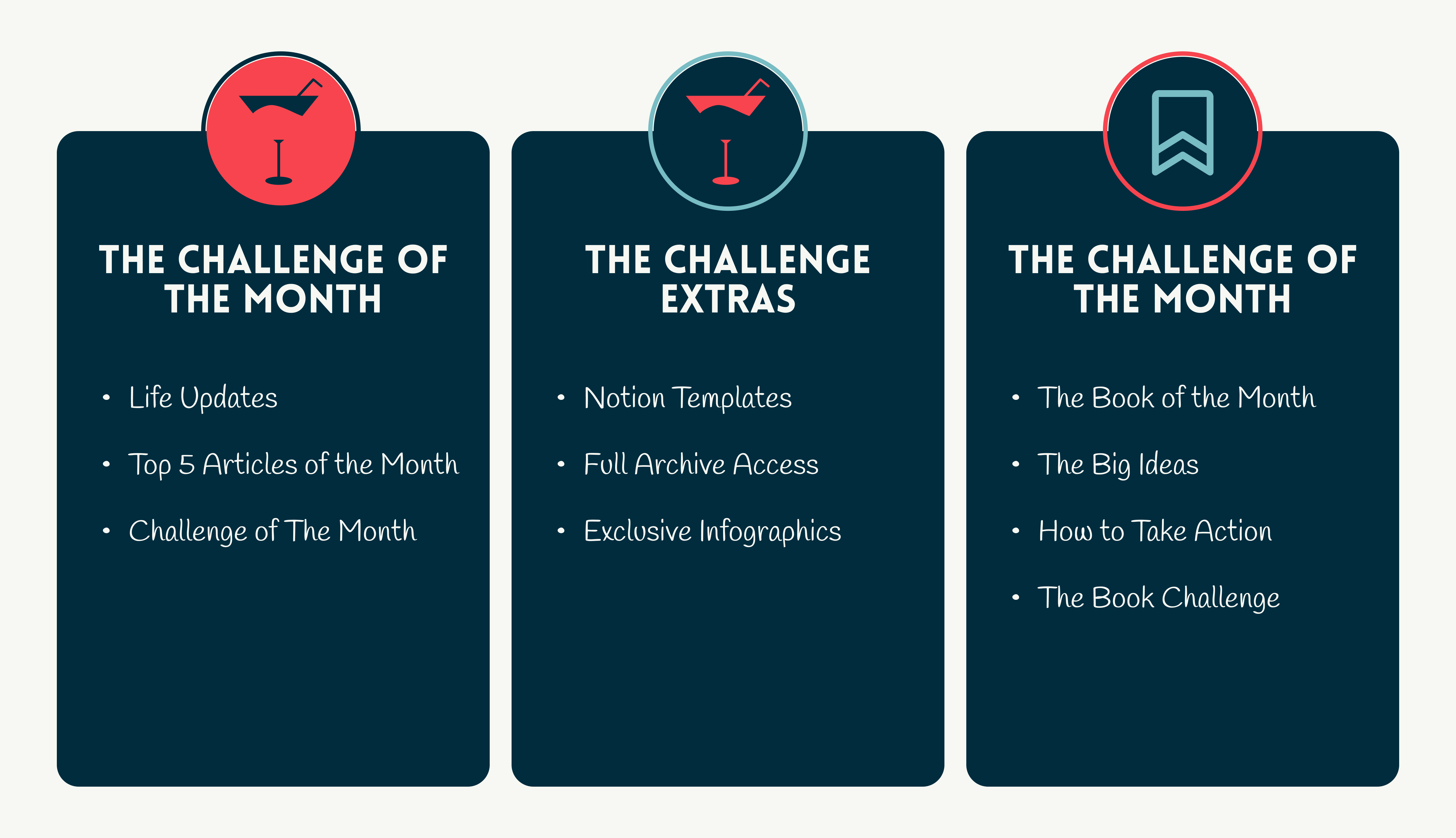
🚀 Unlock the Full Archive, the Productivity Mastery Notion templates, the Top 5 Articles of The Month, and The Challenge Book Club with the premium subscription!
The Painful Physics of Almost
There is a version of your life where you’re six months ahead of where you are now. It’s the same you, with the same skills, and the same hours in the day. But in that version, you didn’t stop when you finished. You did one more.
Let me show you the math of what you’re leaving on the table.
The gap between 90% and 100% completion feels negligible. You’ve done the hard part. The foundation is there. Why obsess over the polish?
Well, that final 10% is the differentiation. Everyone does 90%. Enough gets you by. Enough keeps you employed, busy, and safe from feeling guilty. But enough doesn’t compound. It doesn’t break through. Enough doesn’t build the empire you’re capable of building.
The marginal cost of one more is almost zero, but the compound cost of stopping is devastating.
Let’s say you’re building a product. Every week, you’d hit your development goals. You ship the features you’d planned. You check the boxes. And every week, you’d stop right there.
There was always one more thing you could’ve done. But when you’re done, you’re done. In the long run, you will probably launch three months later than your original deadline because you paid the restart tax. You will pay it every morning, remembering where you left off, rebuilding context, finding the thread.
If you’d done one more thing each Friday, you would have launched on time. Maybe earlier. But you left that empire on the table. Three months of customer feedback. Three months of revenue. And all because you confused finishing the minimum with maximizing the moment.
The Science Behind One More
I know what you’re thinking: “This is just motivational fluff.” Allow me to introduce you to my friend, neuroscience.
The Flow State
First, there’s the flow state research by Mihaly Csikszentmihalyi, who spent decades studying optimal performance states.
Did you know what he found? The first 20-30 minutes of any focused task is the setup cost. Your brain is loading context, suppressing distractions, and building neural pathways. You’re not productive yet. You are investing in productivity.
The payoff comes after that initial investment when you enter the flow state. But flow states don’t end when tasks end. They end when you break the state. That means stopping after completing the task is like paying for a concert, singing the first three songs, and leaving when the singer heats up.
The Zeigarnik Effect (Inverted)
Second, there’s the Zeigarnik Effect, which traditionally tells us that incomplete tasks stick in our minds. But there’s a flip side: completed tasks fade. Your brain closes the file. It deletes the cache and moves on.
If you do one more repetition while still in context, you’re creating a momentum debt. Your brain doesn’t fully close the file, so the next session will be easier to start because you haven’t disengaged.
The Willpower Research
Third, research by Roy Baumeister found that starting an activity requires more willpower than continuing it. The initial activation energy is massive. But once you’re moving, staying in motion requires far less force.
That’s why you shouldn’t stop when you’re done. Always go for one more rep.
The One More Architecture
The strategy is simple. However, it needs more structure because knowing and doing are two different things.
Rule 1: Recognize the completion trap.
The moment you finish something, pause. Don’t move on or shut down. Just pause and ask yourself if you’re stopping because you’ve depleted your energy or because you’ve finished what you were supposed to do.
Most of the time, it’s the latter.
Rule 2: The two-minute test.
If you have two more minutes of focus left, you have enough for one more repetition.
It doesn’t need to be big. One more idea captured. One more edit. Two minutes of focused work while your brain is warm is worth ten minutes of cold-start work.
Rule 3: Stack, don’t start.
The extra thing you do should always flow from your current context. It’s important.
Don’t switch domains entirely. You will lose all the advantage you built up. If you finished writing a blog post, you might draft some social media posts for it, for example. But don’t jump into accounting.
The goal is to use existing momentum without generating new activation energy.
Rule 4: Capture or complete.
If you genuinely don’t have time for one more thing right now, at least capture what that could have been.
Write it somewhere. Make it the first task tomorrow. Give your future self a running start. It would be easier to start from where you left off if you know where you left off.
Rule 5: Celebrate the surplus, not the expected.
Stop celebrating a task that only represents the baseline and celebrate the extra effort.
Did you write one more cold email? That’s the win. Did you edit one more paragraph? It deserves recognition.
Train your brain to crave the surplus, and it will become a habit.
The Regret Audit
Are you with me? Good, let’s do one more exercise. Think about last week now.
When did you stop when you could’ve continued?
Could you have added a case study for that client proposal you sent?
Could you have fixed one more bug on that product you shipped?
Were there more questions you could have asked in that conversation you had?
Those moments where you stopped aren’t failures. They are missed opportunities for compound growth. And the beautiful thing about missed opportunities is that they repeat themselves.
You will get another proposal to write. You will have another product to ship or another conversation to have. Will you stop at “done”, or will you do one more?
The Challenge of The Week
You’ve finished reading this article. You closed the last paragraph. You feel that sense of completion. Your dopamine says, “task accomplished”. And right now, you’re at the crossroads.
You could close this tab, move on with your day, and let everything you read evaporate into good intentions. Or you could do one more thing.
For the next seven days, pause before moving on from every single task you complete. Do you have one more in you? If the answer is yes — and it almost always is — do it.
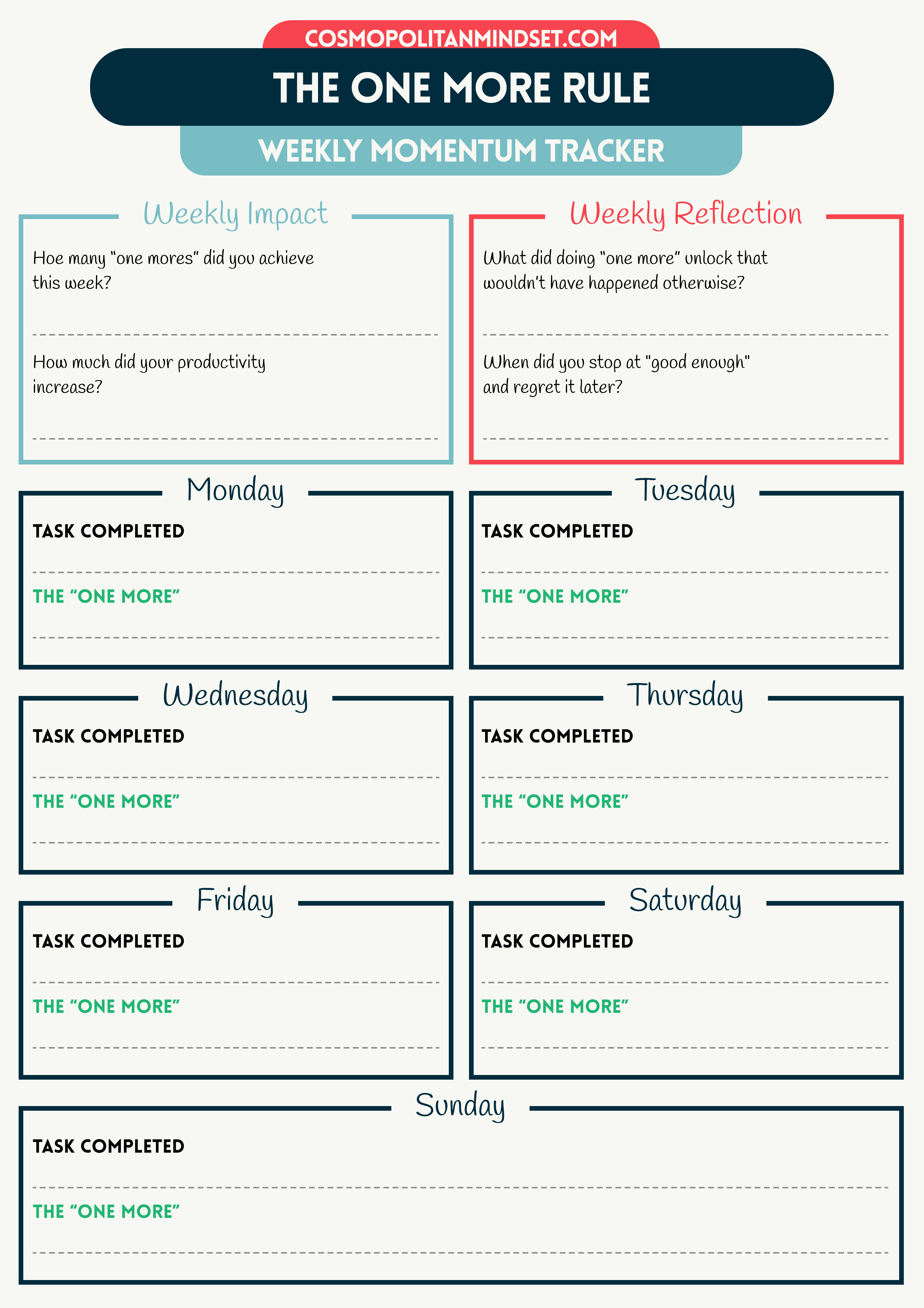
Track what happens. I’m betting you’ll do 30% more meaningful work without adding a single hour to your schedule.
You’re already paying the focus tax. You’re already doing the hard part of starting. You’re already in the zone. All you have to do is stay two minutes longer.
The empire you build won’t come from dramatic pivots or revolutionary strategies. It will come from the accumulation of those “one more” moments.
What’s your one more now?
Before you Go
What’s one thing you will do next before taking that break? Let me know below!
Get The Challenge’s full kit now! Go premium to unlock:
— Cosmin
Thank you, Cosmin!🤓
Brilliant breakdown on the restart tax concept. I've seen this exact pattern at work too where folks ship somthing decent but never quite exceptional because they call it "done" too early. The flow state economics are real btw, once I'm in that zone the extra reps take like 10% of the effort compared to starting cold the next day.