
The Energy Audit: Track This Instead of Time and Watch Your Life Change
Your phone knows it’s dying at 2 PM. Why don’t you? The tracking method that maps your actual capacity.

My battery just died.
I am not talking about my phone — that’s at 47%. I mean my battery. The human one. The one that doesn’t come with a convenient little icon in the corner of my vision telling me I’m about to shut down.
It’s 3:13 PM, and I can feel it happening. That familiar weight settled into my brain like fog. The way my cursor hovers over documents without clicking. The way I’ve reread the same paragraph four times without absorbing a single word. The way deep work has devolved into staring at my screen and pretending I’m thinking.
I have time. Three full hours before my next commitment. My calendar is clear. My to-do list is manageable. Every productivity guru would look at this moment and say, “Perfect! You’ve got a focused work block. Use it!”
But having time and having energy are two completely different things.
The Difference Between Having Energy and Having Time
When teaching you to time-block your calendar, nobody mentions that you could have all the time in the world and still produce nothing because you’re running on fumes.
Your phone is smarter than most productivity systems. It knows that 20% battery at 2 PM is different from 20% battery at 11 PM. It’s aware that certain apps drain faster than others. It knows when to suggest Low Power Mode because it’s tracking the thing that actually matters: energy, not time.
What if you did the same thing?
Tracking energy levels instead of hours feels like putting on glasses after years of squinting at the world. Suddenly, you can see patterns you’d been blind to. You understand why some days you crush your goals while other days you fight yourself over a sentence. You stop beating yourself up for wasting time and start designing your days around your actual capacity.
This isn’t about adding another productivity hack to your arsenal. This is about fundamentally changing the metric you’re optimizing for.
And once you make that shift, everything else clicks into place.
🚀 Unlock the Full Archive, the Productivity Mastery Notion templates, the Top 5 Articles of The Month, and The Challenge Book Club with the premium subscription!
The Battery Metaphor (And Why Your Phone Gets It)
Consider your phone for a moment. What happens when it hits 20%?
It warns you. It suggests Low Power Mode. It stops running background apps. It adapts because it knows something crucial: battery life determines capability, not time.
Your phone doesn’t try to run the same apps at 95% of their capacity that it runs at 15%. That would be stupid and inefficient.
Now think about how we design our days.
We schedule the same type of work at 8 AM and 3 PM. We expect the same focus during back-to-back meetings as we do during protected morning hours. We treat every hour as equal potential. But if you’ve ever tried to write a report at 4 PM on a Friday, you’ll know that’s complete nonsense.
We’re not machines. We’re batteries with fluctuating charge.
Daniel Pink’s work on chronobiology shows we have distinct energy patterns throughout the day. Ultradian rhythms (90-120 minute cycles) govern our ability to focus intensely. So even our cellular biology operates on charge-discharge-recharge cycles.
But here’s what really sold me on the battery metaphor.
I’m someone who alternates between high-energy surges and complete energy crashes. When I’m charged up, I’m unstoppable. Ideas flow. Words appear. Projects finish. But when the slope hits, I don’t want to do anything except scroll on my phone or lose myself in a book.
For years, I thought this made me inconsistent and bad at productivity. I was burning out frequently. Then, I realized I was just using the wrong operating system.

How to Audit Your Energy
You don’t need complicated apps, detailed logs, or guilt about wasted minutes. You only need to track your charge level, not your hours.
Three check-ins per day are enough. And you only need to answer one question:
What’s my battery at right now?
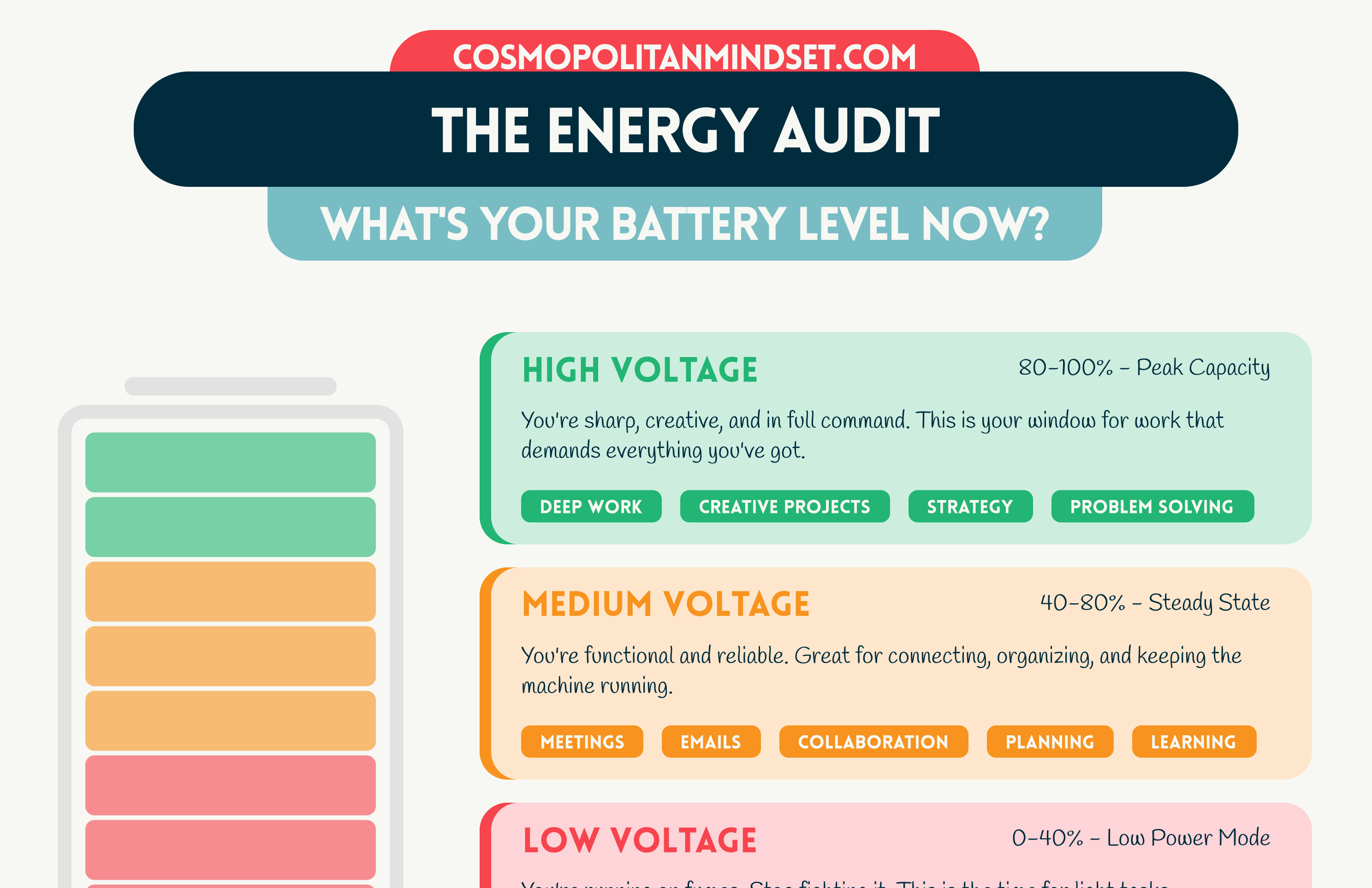
I use a simple three-zone system:
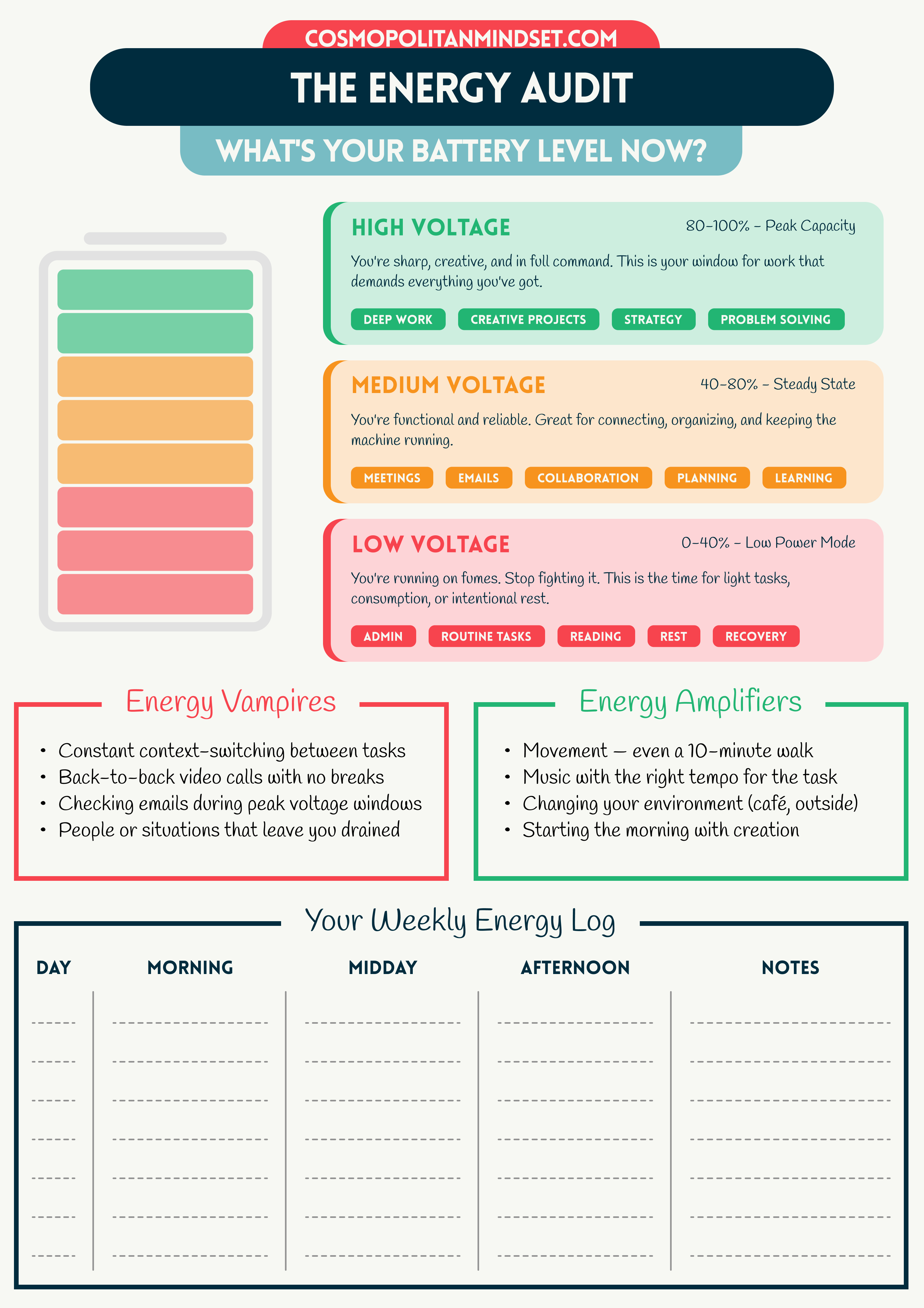
High Voltage (80-100%): You’re sharp and creative. You can discern complex topics and tackle the hard stuff — strategy, creation, problem-solving, and deep work that requires your full mental capacity.
Medium Voltage (40-79%): You’re still functional and can communicate, organize, plan, and perform routine tasks with ease. Luckily, you’re far from empty.
Low Voltage (0-39%): You’re drained and foggy. It’s time for some admin, consumption, or — here’s a radical idea — actual rest.
After one week of tracking, patterns emerge that time tracking never revealed.
You’ll notice that your first 90 minutes of the day are consistently high voltage. The post-lunch slot is almost always a slump. The energy boost you get after a walk or a conversation is palpable.
This is your energy report. And it changes everything.
Discover Your Energy Vampires and Amplifiers
When you start paying attention to your battery, you notice what charges and what drains it.
Energy vampires aren’t always obvious. Everyone knows video calls are exhausting. But did you know that context-switching between projects can drain you faster than working on a single task for three hours straight? Did you know that certain people leave you at 15% every single time?
Energy amplifiers are equally sneaky. Movement charges me up, even just standing while working. Music with a specific tempo. Working from a coffee shop instead of home. Starting the day with creation instead of consumption. These are the power banks you need.
Writing a strategy document when I’m at 35% is torture. Responding to emails when I’m at 95% is wasteful. That’s the cost of being mismatched. And what’s what you need to fix.
How to Redesign Your Day With An Energy Architecture
Once you know your patterns, you can build around them. Here’s how.
1 — Protect Your Peak Voltage Window
Find your highest-energy slot and guard it like a dragon hoarding gold. For most people, it’s the first 90-120 minutes of focused work time. That shouldn’t have meetings, emails, or quick questions.
That first hour before your day explodes with demands is strategy time. It’s creation time and work that compounds.
2 — Match Tasks to Your Battery Level
Create three task lists based on your energy zone:
High voltage: deep work, creative projects, complex problem-solving, and strategic planning.
Medium voltage: meetings, collaboration, planning, organizing, and learning new skills.
Low voltage: admin, email, data entry, reading, research, and routine tasks.
When you sit down to work, check your battery first, then choose from the appropriate list.
3 — Build the Buffer System
When you’re at high voltage, work ahead.
I learned this from necessity because I have high-energy crashes, so I have to make the most of my charged periods. When I’m at 100%, I don’t just do today’s work — I do tomorrow’s and the next day’s. I build a buffer.
This way, when the inevitable slump hits, and I’m at 20% for two days straight, I’m not behind. I’m not panicking. I’m not beating myself up. I’m consuming that buffer, resting, recharging, and knowing I’ve already handled it.
4 — Design Your Low-Power Mode
You need a low-battery mode because without it, you will fall again into the doom-scrolling pattern.
My Low-Power Mode playbook includes admin tasks, reading and answering emails, organizing my tabs by project, and planning. Sometimes, I rest with a good book. Other times, I spend it on Instagram (I’m not perfect). And some other times I take a nap.
5 — Schedule Intentional Recharge
Rest isn’t lazy. It’s strategic maintenance.
Your phone needs to charge overnight. So do you. But you also need micro-recharges throughout the day.
When you’re younger, you can push through it. Your battery is still good, like the new iPhone you just bought. But as you get older, you will need those micro-charges more than anything.
You can take a 15-minute walk. You can remain in absolute silence for five minutes. You could have a conversation that energizes instead of draining you. These aren’t breaks from work; they are investments in capacity.
The Challenge of The Week
My phone is still at 47%. It’ll probably last until evening because it knows how to manage its battery. It adapts. It adjusts. It doesn’t try to run intensive apps when it’s low on juice.
I’m about 60% right now. Not because I managed my time better, but because I stopped fighting my energy. I took a walk. I switched to a lower-voltage task. I let myself recharge instead of forcing my performance.
I did more in the last 90 minutes than in the previous three hours. Not by working harder, but by working aligned.
For one week, track your energy at three checkpoints: morning (within 2 hours of waking), midday (around lunch), and afternoon (3-4 PM).
Note high, medium, or low voltage. What were you doing? How it felt.
That’s it. No judgment. No fixing. Just observation.
The day will always have 24 hours. You can’t manage that. You can’t optimize it. You can’t hack your way into a 25th hour.
But you can manage your energy. You can optimize your charge. You can align your tasks with your capacity.
And when someone asks why you’re checking your battery in the middle of the afternoon, just smile and tell them: “My phone taught me something important.”
Before You Go
Now go check your battery. What are you actually running on right now?
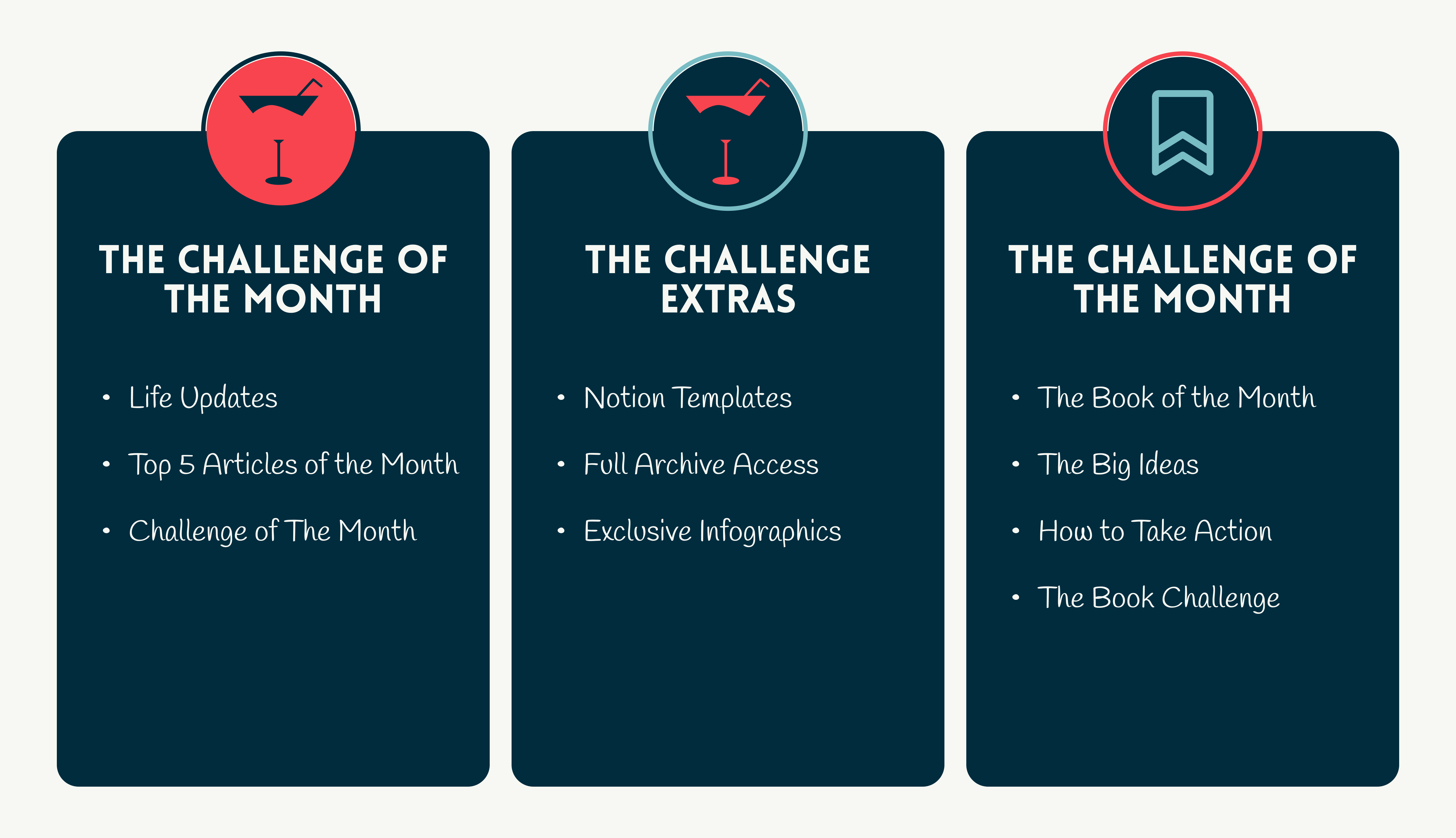
Get The Challenge’s full kit now! Go premium to unlock:
— Cosmin