
The Character Architect: How to Design Your Future Self Like an RPG Character
Why most people fail at becoming who they want to be (and the gaming framework that fixes it)

I’m 15 years old, staring at a character creation screen.
It’s 2 a.m. My parents think I’m asleep. The glow from my monitor is the only light in the room, and I’m about to make one of the most important decisions of my young life: What kind of Elf will I be?
World of Warcraft, a game my parents gave me months ago, was still wrapped in plastic until tonight. Now I’m scrolling through classes, agonizing over skill trees I don’t fully understand, feeling the weight of a choice I can’t take back.
I decide to build a Druid. The screen shows me options — Balance, Feral, Restoration — each one promising a different version of who I could become in this digital world. Each one has trade-offs. Each one shaping the next thousand hours of my life.
I choose Feral. Within weeks, I realize something magical: I can shapeshift.
One moment, I’m a bear, absorbing damage and protecting my team. Next, I’m a cat, dealing quick bursts of damage. And when things get desperate, I can shift to a caster form and heal.
I’m not locked into one identity. I’m fluid. I’m multiple things at once, and it feels empowering.
I felt more powerful in that game than I did in real life.
Fast forward fifteen years, and I’m sitting at my desk, scrolling through LinkedIn. I watch people who seem to have it all figured out. They have clear career paths. They know their strengths. They’ve built identities that fit, while I’m still at that character creation screen, paralyzed by the same question I had at 15:
What kind of person am I supposed to be?
The Most Important Skill You’re Never Taught In Life
The character creation screen I saw at 15 is the most important skill you’re never taught in life. Nobody teaches you to assess your strengths, identify your weaknesses, or decide where to invest your limited resources.
I had to learn it from a fantasy game!
You stumble into adulthood with some innate traits. You may be naturally resilient, quick-thinking, or skilled at interacting with people. And even if nobody tells you how to use those, you’re supposed to know what to do with them.
You must have a plan. A direction. A clear sense of who you’re becoming. But you don’t.
Everyone seems to have figured it out. They have their identities locked in. They know their role. They’re playing their class with confidence. But you’re still stuck at the character creation screen, paralyzed by the fear you’ll pick wrong and waste your life on a build that doesn’t fit.
That fear drives you to make wrong choices. You do what most people do: you copy someone else’s build. You follow the meta and become what you think you’re supposed to be, not what you’re designed to be. And it feels wrong. Slow. Like you’re playing a Tank when you were born to be a Mage.
What if you could reverse-engineer your identity as you do with your video game characters? What if you could identify your base class, understand your starting stats, and strategically allocate skill points across different domains to become exactly who you want to be?
That’s what we’re doing today.
By the end of this article, you’ll know your archetype, understand how to distribute your life’s skill points, and have a framework for building yourself a character you want to play for the next 50 years.
Let’s start with the part everyone gets wrong.
🚀 Unlock the Full Archive, the Productivity Mastery Notion templates, the Top 5 Articles of The Month, and The Challenge Book Club with the premium subscription!
The Character Creation Lie
Most self-help advice focuses on goals, destinations, and finish lines.
“Set a 10-year vision. Reverse engineer your life. Build a roadmap to success.”
It sounds strategic and smart, but it completely misses the point.
Goals change. Markets shift. Opportunities appear and disappear. The promotion you wanted gets eliminated in a restructure. The business you planned to build might become obsolete. The degree you spent four years earning leads to a field you hate.
Your character build is permanent.
Not in the sense that you can’t change it. We’ll talk about “respeccing” later. But in the sense that who you are shapes what you can do far more than your goals ever will.
A Tank doesn’t suddenly become a DPS because they set a goal to deal more damage. They’re built for resilience and absorption. They can develop offensive abilities, but their core strength will always be staying power.
This is why you see people burn out when chasing goals that don’t align with their archetype. The naturally introspective Mage can’t force themselves into a high-energy sales role. You can’t thrive in a fast-execution environment if you’re a strategic thinker. And you can’t pivot into creative work if you’re a resilient grinder.
They’re not failing because they lack discipline or drive. They’re failing because they’re playing in the wrong class. Instead of starting with archetype awareness and designing their progression, they are trying to set goals and work backwards.
The Five Core Archetypes
Every character in an RPG starts with a base class. That’s their foundation, the set of innate traits that define how they interact with the world.
You have one too. You’ve always had one. You just never named it.
Let me introduce you to the five archetypes. As you read through them, pay attention to which one makes you think, “Oh, that’s me!” Not the one you wish you were. Not the one that sounds most impressive. But the one that feels like home.
The Tank: The Resilient Builder
Tanks are built to endure. They have high emotional and physical resilience. They can absorb setbacks that would break other archetypes. They’re the ones who keep going when everyone else has quit.
Superpower: Consistency. They show up every day, even when motivation is gone. They’re the marathon runners of life. The ones who build empires slowly, brick by brick, year after year.
Weakness: Speed. Tanks are slow to adapt. They struggle with rapid pivots. They need time to process, strategize, and commit their attention. When a Tank tries to move like a DPS, they burn out.
You’re a Tank if you can handle stress better than most people. You’re reliable. People call you when they need someone steady. However, you feel frustrated when things change rapidly, and you envy people who can execute in those moments.
The DPS: The Executor
DPS classes are built for output. High energy, fast execution, explosive productivity. They’re the sprinters. The ones who see a problem and immediately start solving it.
Superpower: Speed. When a DPS is in flow, they’re unstoppable. They can accomplish in three hours what takes others three days. They thrive on momentum, bursts of creativity, and rapid iteration.
Weakness: Sustainability. DPS archetypes crash hard when the flow breaks. They struggle with slow, methodical work. They get bored easily. And when obstacles interrupt their momentum, they spiral.
You’re a DPS if you work in intense bursts. You love starting new projects but struggle to finish them. You’re great in a crisis but terrible at routine maintenance. People describe you as “intense” or “a force of nature.”
The Support: The Amplifier
Supports don’t shine alone. They shine through others. They’re the connectors, the morale boosters, the ones who make everyone around them better.
Superpower: Social capital. Supports build networks effortlessly. They read people, create alignment, and turn groups of individuals into cohesive teams. They’re force multipliers.
Weakness: Solo performance. Supports struggle when isolated. They need collaboration, interaction, and human connection to thrive. When a Support tries to operate alone, they feel drained and directionless.
You’re a Support if you light up in group settings. You’re the one people come to for advice, mediation, or encouragement. But working alone feels hollow. You need a team, a community, a party to feel like you’re playing at full capacity.
The Mage: The Strategist
Mages are the planners. The thinkers. The ones who see ten steps ahead and optimize for long-term outcomes. They live in their minds.
Superpower: Intelligence. Mages excel at pattern recognition, systems thinking, and strategic planning. They’re the architects. They design frameworks, spot inefficiencies, and build leveraged systems.
Weakness: Overthinking. Mages get stuck in analysis paralysis. They delay execution because they’re still refining the plan. And when caught off-guard without preparation time, they panic.
You’re a Mage if you love frameworks, models, and mental maps. You’re great at anticipating problems but struggle with starting and figuring things out. People think you’re smart, but you feel like you’re always three steps behind the fast-movers.
The Shapeshifter: The Adapter
Shapeshifters are the hybrids. The generalists. They can shift contexts, roles, and modes depending on the situation.
Superpower: Adaptability. Shapeshifters learn fast, pivot easily, and thrive in ambiguity. They’re the ones who can code in the morning, write in the afternoon, and lead a meeting in the evening.
Weakness: Depth. Shapeshifters struggle with mastery. They’re good at many things but rarely great at one thing. They envy specialists who can go deep and become world-class in a single domain.
You’re a Shapeshifter if you have diverse interests and skills. You get bored specializing. You thrive in variety but feel guilty for not picking a lane. People ask, “What do you do?” and you struggle to answer in one sentence.
The 6 Core Stats of Your Skill Tree
Now that you know your base class, we need to discuss where you’re putting your points.
In an RPG, your character has a skill tree. You earn experience points, level up, and allocate those points across different abilities. Some builds put everything into offense. Others balance defense and utility. But the best builds are intentional.
Your life has a skill tree, too. Six core stats that determine your effectiveness across every domain:
Health: Your physical resilience. Energy levels. Stamina. Recovery speed.
Intelligence: Learning capacity. Pattern recognition. Strategic thinking.
Charisma: Social influence. Relationship quality. Persuasion skills.
Agility: Adaptability. Execution speed. Ability to pivot quickly.
Creativity: Innovation. Problem-solving. Original thinking.
Resilience: Emotional stability. Persistence. Ability to endure setbacks.
Most people never audit where their points currently are. They assume they’re balanced. But when you map it out, you realize you’ve been neglecting entire stats while over-investing in others.
Do you build brilliant strategies but burn out every six months? You have high intelligence but low health.
Do you have amazing ideas, but never turn them into reality? You have high creativity but low agility.
Are you loved by everyone but struggle financially? You have high charisma but low intelligence.
Your archetype determines your starting stat distribution. But you decide where to allocate your next points.
The question isn’t “What should my stats be?” The question is: “What stats do I need to develop to become the version of myself I want to play as?”
The Multi-Class Strategy
Remember my Druid?
I didn’t love that character because I was the best tank, or the best DPS, or the best healer. I was decent at all three. And that versatility made me invaluable.
When my team needed someone to absorb damage, I could shift into bear form. When we needed burst damage, I could shift into cat form. When someone was about to die, I could heal them.
I wasn’t locked into one identity. I was fluid. This is the secret most people miss: pure builds are fragile. Hybrid builds dominate.
The most effective people I know are hybrids. They have a primary archetype, a core identity they build from, but they’ve also developed secondary traits that make them adaptable.
I call it the 70/30 Rule. Invest 70% of your energy in developing your core archetype and 30% developing your strategic complement.
Don’t try to become someone you’re not. A Tank will never be a pure DPS, and that’s fine. Yet, a Tank who develops 30% DPS traits can endure and execute. That’s a build that wins.
When To Rebuild Your Character
Sometimes, you realize you’re playing in the wrong class. Not because you picked wrong at the start, but because you’ve changed. Maybe the plan changed. Or the game changed. Or you’ve outgrown the build that got you here.
In most RPGs, you get a “respec” — a chance to redistribute all your skill points and rebuild your character from scratch without losing your level.
In the same way, real life has respec moments, too. And recognizing them is crucial.
You need a respec when:
You feel like you’re operating at 60% capacity, no matter how hard you try.
You look at people in adjacent roles and feel deep, persistent envy.
Your natural strengths feel irrelevant to the work you’re doing.
You’re succeeding by conventional metrics but feel completely misaligned.
At 27, I had my respec moment. I was working in a role that rewarded long-term commitment. It was perfect for a Tank. But that wasn’t me. I was a Shapeshifter who had been playing Tank because it seemed like the smart path.
I needed variety. I needed to shift between modes. I needed to write, build, strategize, and execute. So, I respecced.
I didn’t start from zero. I kept my resilience points — that endurance didn’t disappear. But I reallocated my focus and invested in agility and creativity. I built a life where I could shift between roles instead of being locked into one.
Respeccing doesn’t mean you lose progress. It means you redistribute your points to match who you’ve become. The key is recognizing when the build isn’t working anymore and having the courage to redesign it.
How to Build Your Character Sheet
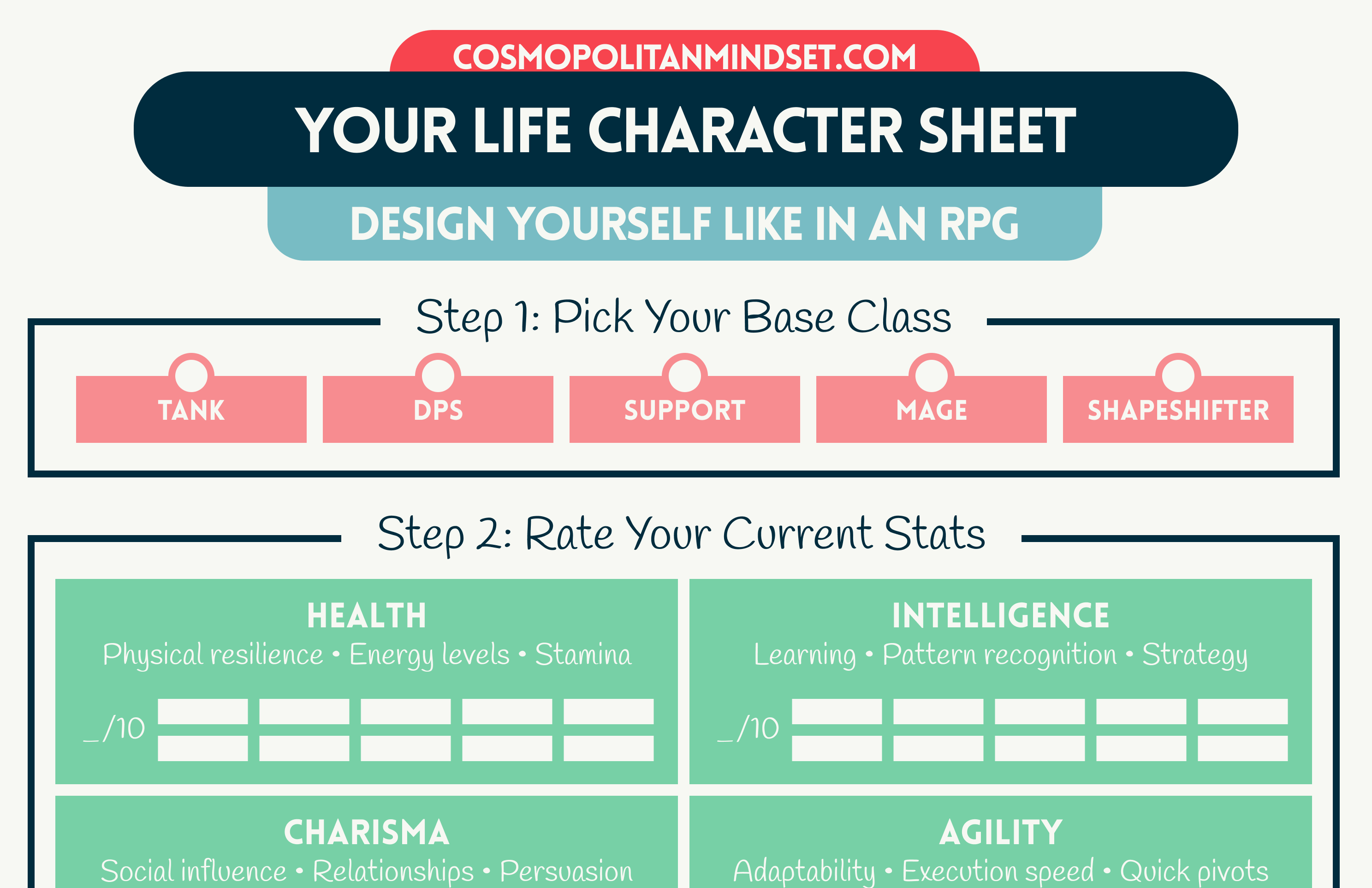
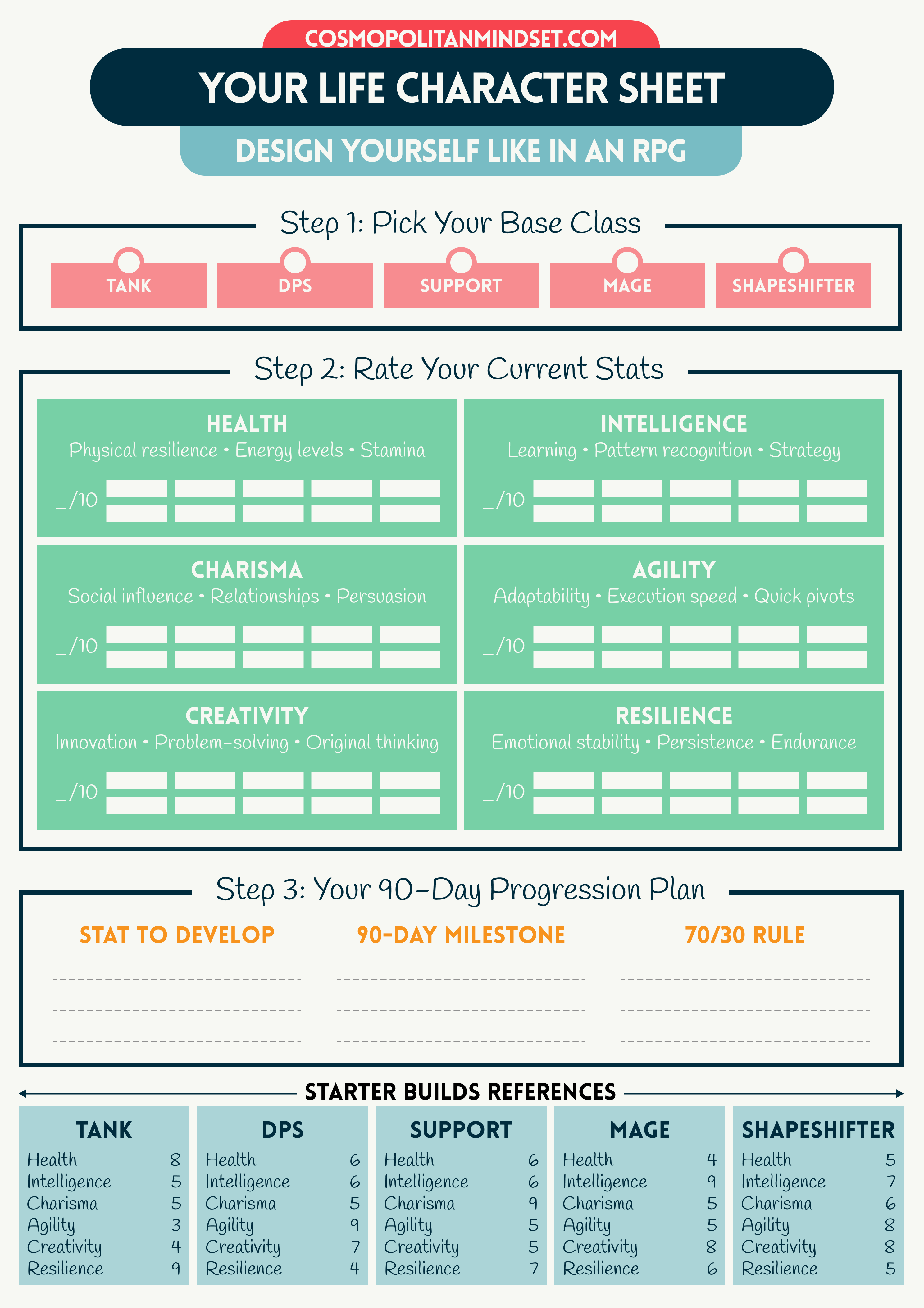
Enough theory. Let’s make this real. Now, you’ll design your character sheet (and I’ll provide a graphic to help you do that below).
Step 1: Identify Your Base Class
Go back to the five archetypes. Which one feels most natural?
Don’t pick the one you admire. Pick the one that describes how you already operate when you’re not forcing yourself to be someone else.
Write it. “I’m a [Tank/DPS/Support/Mage/Shapeshifter].”
Step 2: Audit Your Current Stats
Rate yourself honestly on each stat (1-10):
Health → physical energy and resilience
Intelligence → strategic thinking and learning speed
Charisma → social influence and relationships
Agility → adaptability and execution speed
Creativity → innovation and original thinking
Resilience → emotional endurance and persistence
Look at the distribution. Where are your points concentrated? Where are you neglecting yourself?
Step 3: Choose Your Strategic Complement
What secondary trait would make you most effective based on your archetype?
If you’re a Tank, develop Agility. Learn to move faster.
If you’re a DPS, develop Resilience. Learn to sustain your output.
If you’re a Support, develop Intelligence. Learn to operate solo.
If you’re a Mage, develop Agility. Learn to act before the plan is perfect.
If you’re a Shapeshifter, pick ONE stat to master. Commit to depth.
Step 4: Design Your 12-Month Progression
What would leveling up look like in your chosen stat?
If you’re building health, what’s your next milestone? Running 5K without stopping? Sleeping 7+ hours consistently? Having energy at 5 p.m. instead of crashing?
If you’re building agility, what’s your next milestone? Launching something in 30 days? Making decisions in hours instead of weeks?
If you’re building Charisma, what’s your next milestone? Leading a meeting confidently? Building three new meaningful relationships? Getting comfortable with public speaking?
Pick one milestone for the next 90 days. One stat. One measurable outcome. That’s your first quest.
Step 5: Find Your Party
You can’t win any RPG alone. You need a party: a group of players with complementary builds.
Who’s in your group right now?
Do you have a DPS in your life if you are a tank? Do you have a Support that can help you connect with people if you are a Mage?
The best players don’t build themselves. They build teams where everyone’s archetype complements the others.
The Challenge of The Week
For the next seven days, live like someone who’s consciously designing their character.
Create your character sheet. Identify your base class and your current stat distribution. Pick one stat to develop over the next 90 days.
Pay attention to when you feel like you’re playing your class versus someone else’s. Notice when you’re investing in the right stats versus the ones society tells you to care about. Notice when you’re in flow versus when you’re forcing it.
I’m still at that character creation screen sometimes, still figuring out which stats to invest in next, still shapeshifting between modes when the situation demands it. But I’m not playing on default settings anymore. I am not copying someone else’s build. I’m designing my own.
Fifteen years after that Druid taught me what it felt like to choose who I become, I’m finally doing it in real life.
You can too. You just have to hit ‘Create Character.’
Your build is waiting.
Before You Go
What type of build did you start with, and what are you building towards? Let me know below!
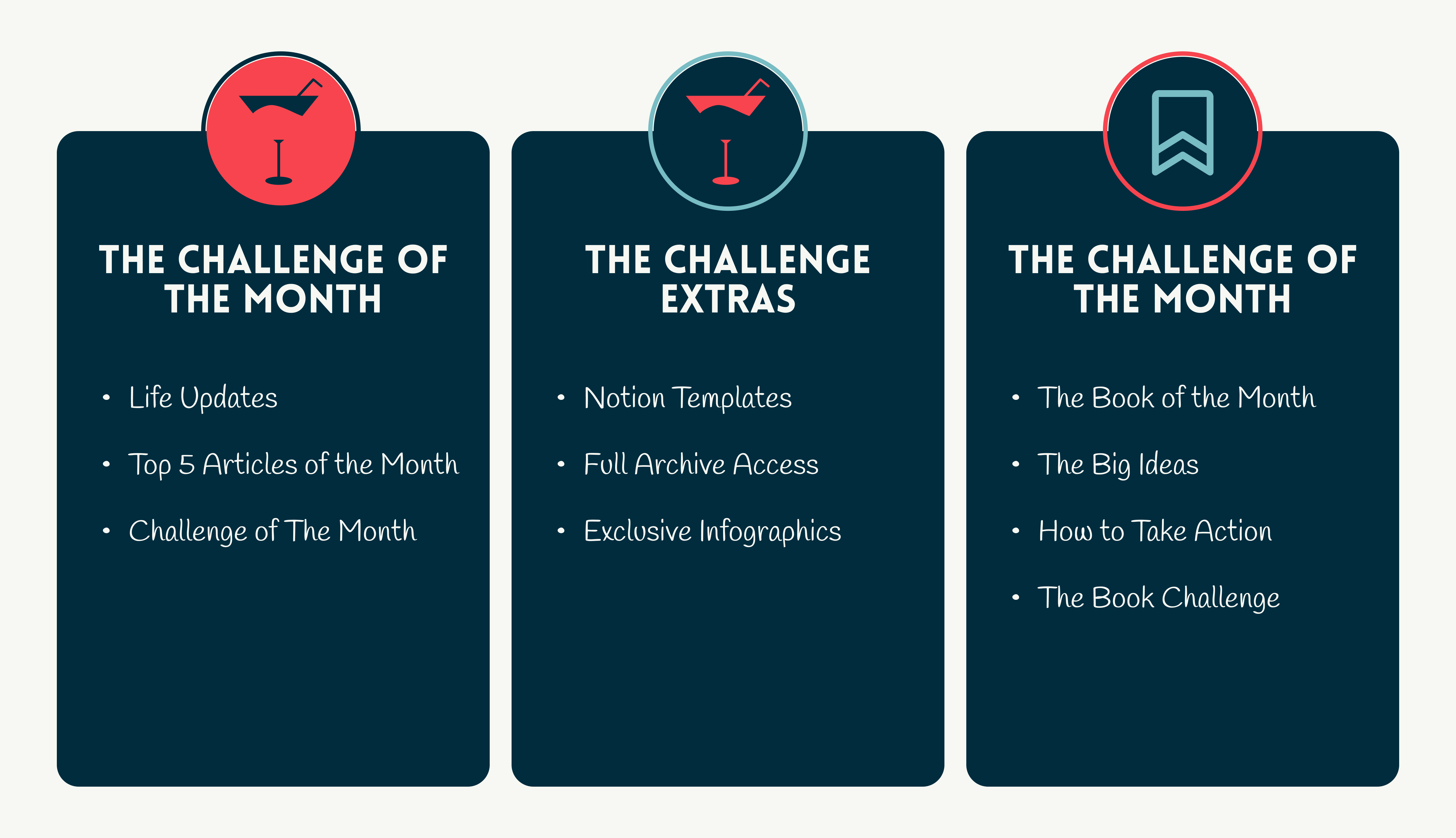
Get The Challenge’s full kit now! Go premium to unlock:
— Cosmin